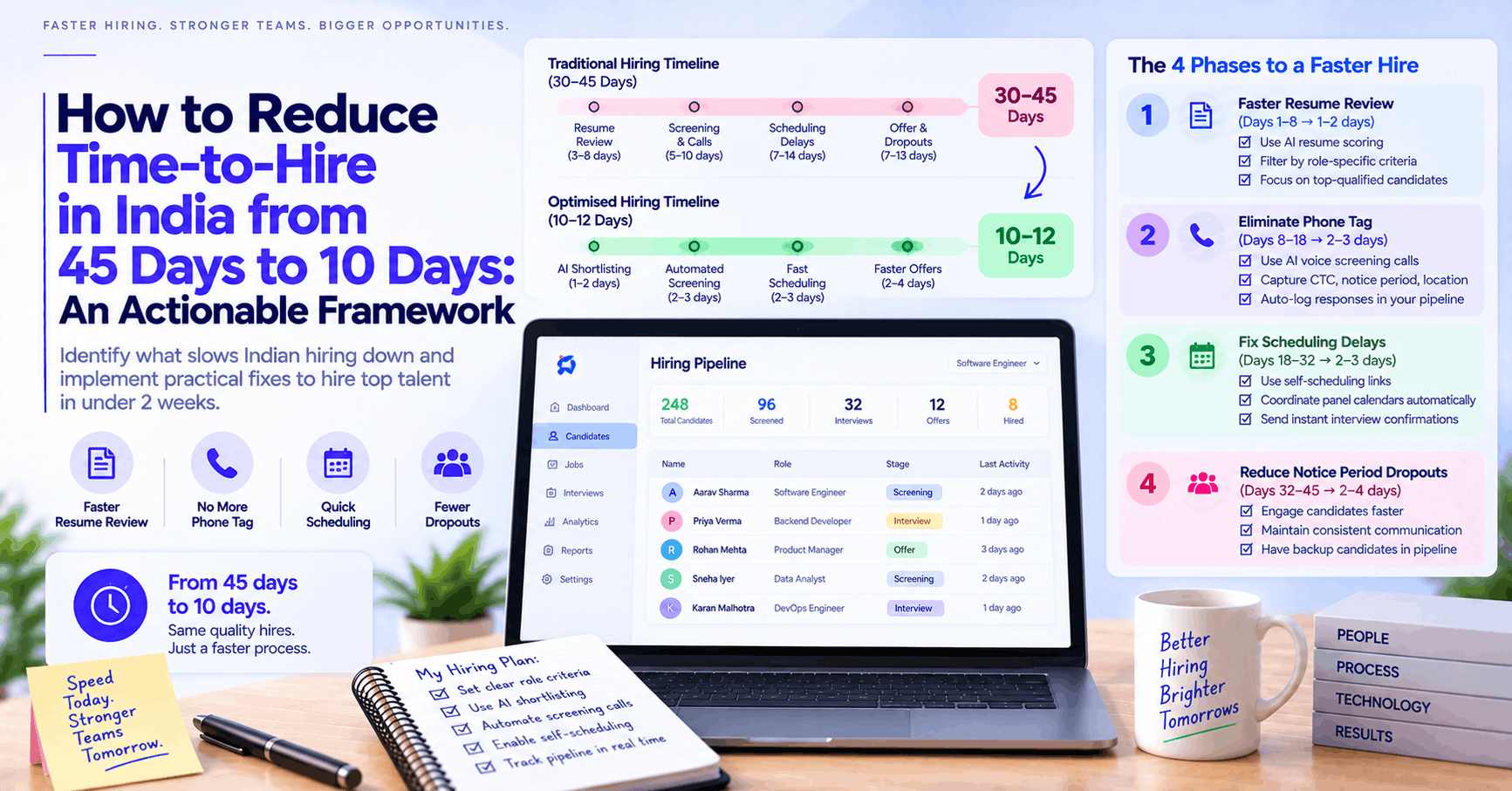
The average time-to-hire for mid-level roles in India runs 30–45 days. For high-growth startups competing for the same engineering and product talent as well-funded competitors, 45 days is the time between losing a candidate to another offer and starting the search over. This framework identifies the four specific phases where Indian hiring stalls — slow resume review, phone tag, scheduling delays, and notice period dropouts — and gives concrete, implementable fixes for each. With the right process and tooling, 10–12 days from application close to verbal offer is achievable for most roles. The foundation is a visual ATS pipeline tracking system where every candidate's stage, status, and next action is visible in real time — not reconstructed from email threads.
Why 45 days is the wrong baseline to accept
The 30–45 day average isn't an immutable feature of Indian hiring — it's the result of a process that was never designed for speed at multiple critical junctions. Each of those junctions is identifiable, measurable, and fixable.
What makes Indian hiring specifically slower than equivalent markets isn't primarily the candidate selection decision — it's the infrastructure around that decision: how candidates are found, how they're screened, how interviews get scheduled, and what happens during the notice period after an offer is accepted. These are operational problems, not judgment problems, and operational problems are much more tractable than improving hiring judgment.
Before the framework: a brief note on what "time-to-hire" means here. We're measuring from the point a recruiter begins active work on a role (sourcing or application review starts) to the point a verbal offer is accepted. Notice period — which in India can add another 30–90 days before the hire actually joins — is a separate, significant challenge addressed in Phase 4. The 10-day target refers to the pre-offer timeline.
Phase 1: Slow resume review and poor initial shortlisting (Days 1–8 in the average process)
What's actually happening
A role closes applications. 200 resumes have come in. A recruiter begins reviewing them one by one, a task that takes three to four working days at careful attention, longer if competing priorities intervene. The shortlist that emerges is inconsistent — the first 50 resumes get more careful attention than the last 50, simply because fatigue affects judgment. Borderline candidates get different treatment based on who reviewed them and when.
Meanwhile, the job has been open for a week and strong candidates — who applied to three similar roles the same day — have already received calls from the other two.
The fix: AI resume scoring against role-specific criteria before human review
Define three to five non-negotiable criteria for the role before applications start arriving: minimum years of relevant experience, specific technical skills, acceptable notice period, location. Apply these as an automated filter to rank incoming applications, so a recruiter's review time is concentrated on the top quartile of applications rather than spread equally across all of them.
This isn't about removing human judgment from hiring decisions — it's about applying human judgment to the right subset of candidates rather than to every application regardless of obvious fit. A recruiter reviewing the top 50 applications from 200, ranked by role-specific criteria, makes better decisions and makes them faster than the same recruiter reviewing all 200 sequentially.
The practical time reduction: a process that was taking 3–4 days of review time before a shortlist was ready compresses to same-day or next-day shortlisting for most roles. That alone removes 2–3 days from the average timeline.
Phase 2: Phone tag and screening delays (Days 8–18 in the average process)
What's actually happening
The shortlist is ready. A recruiter needs to verify basics with each shortlisted candidate: current CTC, expected CTC, notice period, location flexibility, open to the role's work mode. This requires actually reaching each candidate — which requires the candidate to be available when the recruiter calls, or the recruiter to be available when the candidate calls back, or three rounds of missed calls before a conversation happens.
For a shortlist of 25 candidates, each requiring a 10-minute verification call, the manual dialling overhead is 4–6 hours of recruiter time spread across multiple days. Candidates who apply on Friday and don't hear from anyone until Wednesday have had four days to accept a competing offer.
The fix: AI voice screening clears the basic qualification round automatically
For roles where first-round screening is straightforward data-gathering — CTC, notice period, location, availability — an automated voice screening call handles the entire shortlist simultaneously rather than sequentially. Calls go out the day the shortlist is generated; results come back the same evening or the following morning.
The recruiter reviews outcomes rather than conducting them: which candidates cleared all basic criteria, which have blockers (notice period too long, CTC expectation above budget, wrong location), which didn't connect and need a follow-up. Human time at this phase shifts from conducting 25 screening calls to reviewing 25 screening outcomes — a task that takes 30–45 minutes rather than two days.
Candidates who connect and qualify can have an interview invitation triggered the same day their screening call is completed, removing the 24–48 hour gap that often exists between "screening done" and "invitation sent" in manual processes.
Phase 3: Interview scheduling delays (Days 15–30 in the average process)
What's actually happening
A recruiter needs to schedule interviews for 12 candidates with 3 interviewers who have different availabilities across the next two weeks. The coordination involves: emailing 12 candidates with proposed times, waiting for responses, discovering conflicts, proposing alternatives, checking back with interviewers when a proposed time doesn't work, rebooking when a candidate or interviewer reschedules, and finally confirming 12 separate calendar events with meeting links.
This process, done manually over email, routinely takes 5–7 days from "ready to interview" to "all interviews scheduled." Some candidates drop out during this window — not because they're not interested, but because a competing offer arrived while they were waiting for a calendar invite.
The fix: candidate-driven scheduling against real calendar availability
The email coordination loop exists because of a fundamental information asymmetry: the recruiter knows which interviewers are available, but not in real time, and candidates know their own availability but not the interviewer's. The fix is sharing real availability directly with candidates.
Automated interview scheduling integrated with interviewer Google or Outlook calendars lets a candidate select a slot from genuinely available windows, immediately triggering a calendar hold for both parties and generating a meeting link automatically. No back-and-forth. No email chain. No manual calendar entry by a recruiter.
A scheduling process that was taking 5–7 days compresses to 24–48 hours: candidates receive the scheduling link the day interviews are ready to begin, most book within a few hours, and a recruiter's role in this phase shifts from coordinator to monitor.
The practical time reduction at this phase alone — from 5–7 days to 1–2 days — is often the single largest contributor to overall time-to-hire improvement, precisely because it's both the most consistently slow phase and the easiest one to fix with the right tooling.
Phase 4: The notice period dropout gap (Days 30–120 after offer)
What's actually happening
An offer is accepted. The candidate has a 60-day or 90-day notice period. For the next two months, they remain embedded in their current employer's environment, fully available for a counter-offer conversation, and increasingly distant from the initial excitement of the new opportunity.
Counter-offers in India are common and often substantial — particularly in competitive skill categories where employers know a quality employee is hard to replace. A candidate who accepted your offer on Day 30 may be back at their current company by Day 120 if the process after acceptance is handled as an administrative dead zone rather than an active engagement period.
This isn't measured in the standard time-to-hire metric, but it's the phase with the most dramatic impact on whether a completed hire actually results in someone joining.
The fix: treat the notice period as an active engagement phase
The candidate who accepted your offer needs to be engaged throughout the notice period — not just at the start (offer acceptance) and the end (joining logistics). This means scheduled check-ins at defined intervals, direct contact with the future manager and team rather than only the recruiter, and sharing context about the role and team that reinforces the decision they made.
The specific cadence: a welcome message within 24 hours of offer acceptance, a recruiter or manager touchpoint in Week 2, an informal team introduction in Week 4, a role-related update (project they'll be joining, team news) in Week 6, and practical joining logistics in the final 2 weeks. Each touchpoint is brief — the goal is keeping the new opportunity emotionally present, not overwhelming the candidate during a stressful transition period.
Channel matters here too: a WhatsApp message from the future manager tends to land differently than an email from the HR team. The informality signals a genuine relationship rather than an administrative process.
Putting the framework together: the 10-day timeline
- Day 1: Applications scored and ranked automatically; top shortlist identified by end of day
- Day 2: AI voice screening calls sent to entire shortlist; outcomes logged overnight
- Day 3: Recruiter reviews screening outcomes (30–45 min); qualified candidates sent interview scheduling links same day
- Days 3–5: Candidates self-schedule; most slots fill within 24–48 hours
- Days 4–7: Interviews happen (2-stage: hiring manager screen + team/technical panel)
- Day 8: Debrief and decision (1-hour internal meeting with all interviewers present or feedback collected from pipeline)
- Days 9–10: Verbal offer extended; formal letter follows
- Day 11+: Notice period engagement begins immediately
This timeline requires genuine pre-work: screening criteria defined before applications open, interviewers briefed and calendar slots blocked in advance, offer approval authority pre-granted for standard compensation bands. None of this is technically difficult — it's process discipline that most hiring teams haven't formalised.
What prevents most teams from achieving this
- Interviews aren't pre-committed. Interviewers who haven't blocked specific windows for interviewing aren't available when a recruiter needs them — which is the root cause of most scheduling delays. Solving this isn't a technology problem; it's a calendar management agreement that needs to happen before sourcing begins.
- Offer approval chains are slow. If extending a verbal offer requires finance approval, a multi-layer management sign-off, or a compensation committee decision, no amount of front-funnel speed saves time at this stage. Pre-approving compensation bands for standard role levels removes this bottleneck.
- Feedback doesn't get collected promptly. A decision that waits on an interviewer who hasn't submitted feedback three days after the interview is a process gap, not a technology gap. A 24-hour feedback deadline — enforced by a platform that automatically reminds interviewers and notifies the recruiter of missing responses — is the fix.
- The pipeline isn't visible in real time. When the current status of every candidate in the process isn't visible at a glance, recruiters spend time reconstructing status from email threads rather than acting on it. A visual ATS pipeline tracking system — where every candidate's stage, last action, and next step is visible without opening a single email — removes this overhead entirely.
Measuring your starting point before optimising
You can't improve what you don't measure. Before implementing any of the above, pull the last 10–15 completed hires and calculate actual time spent in each phase:
- Application close to shortlist ready: typically 2–5 days
- Shortlist to screening complete: typically 3–7 days
- Screening complete to all interviews scheduled: typically 3–7 days
- First interview to verbal offer: typically 3–7 days
- Offer acceptance to joining: notice period (separate metric, track dropout rate here)
Whichever phase shows the largest gap relative to what it should take is your highest-leverage fix. For most Indian hiring teams, Phase 3 (scheduling delays) and Phase 2 (screening phone tag) are the biggest contributors — which is precisely why fixing those two phases alone typically halves overall time-to-hire before any other change is made.
Frequently asked questions
What is the average time-to-hire in India by role type? Entry-level and support roles: 15–25 days. Mid-level roles (2–7 years experience): 30–45 days. Senior and specialist roles: 45–75 days. Leadership and C-suite: 60–120 days. These are averages — the upper end of each range is where manual processes without automation tend to cluster, and the lower end reflects what organised, tool-supported processes achieve. The 10-day target in this framework is realistic for mid-level roles at teams that have implemented the fixes above; it's harder to achieve for senior or specialised roles where the candidate pool is genuinely small.
Does faster hiring mean lower quality hires? Only if speed is achieved by skipping evaluation steps rather than removing process friction. A well-structured process that uses AI screening and scheduling automation to remove delays between steps — not to shortcut the evaluation itself — can be both faster and more consistent than a manual process. The structured screening rubric and consistent interview framework that make the 10-day timeline work also make the evaluation more rigorous, not less.
What's the single highest-impact change for most Indian hiring teams? Interview scheduling automation. Most teams underestimate how much time is lost between "candidate is ready to interview" and "interview is actually scheduled" — the 5–7 day email coordination loop described in Phase 3. This is also the easiest phase to fix with technology, and the one where the time saving is most reliably consistent across different role types and candidate pools.
How does notice period affect the effective time-to-hire metric? In the standard definition, time-to-hire ends at offer acceptance. Notice period is a separate metric — sometimes called "time-to-join" — that matters enormously for planning purposes but is often outside a recruiter's direct control. The offer-to-joining dropout rate (what percentage of accepted offers result in the person actually joining) is the metric to track alongside time-to-hire; teams that don't track it often don't know how much their candidate engagement during notice period is affecting actual headcount outcomes.
Is it realistic to achieve 10-day time-to-hire for senior roles? For senior individual contributor or manager-level roles with a reasonably clear specification, yes — with the full framework above implemented. For VP-level and C-suite roles, where the candidate pool is small, the evaluation process involves multiple rounds with senior stakeholders, and the decision itself takes longer to reach alignment on, 10 days is typically too aggressive. A more realistic target for senior hiring is 20–25 days, still significantly below the 45–60 day average for that level.
Compress your hiring cycle with RecruitKar's automated funnel. From AI resume scoring on Day 1 to scheduled interviews by Day 3 — visual ATS pipeline tracking and AI-powered recruiting platform built for Indian hiring teams.