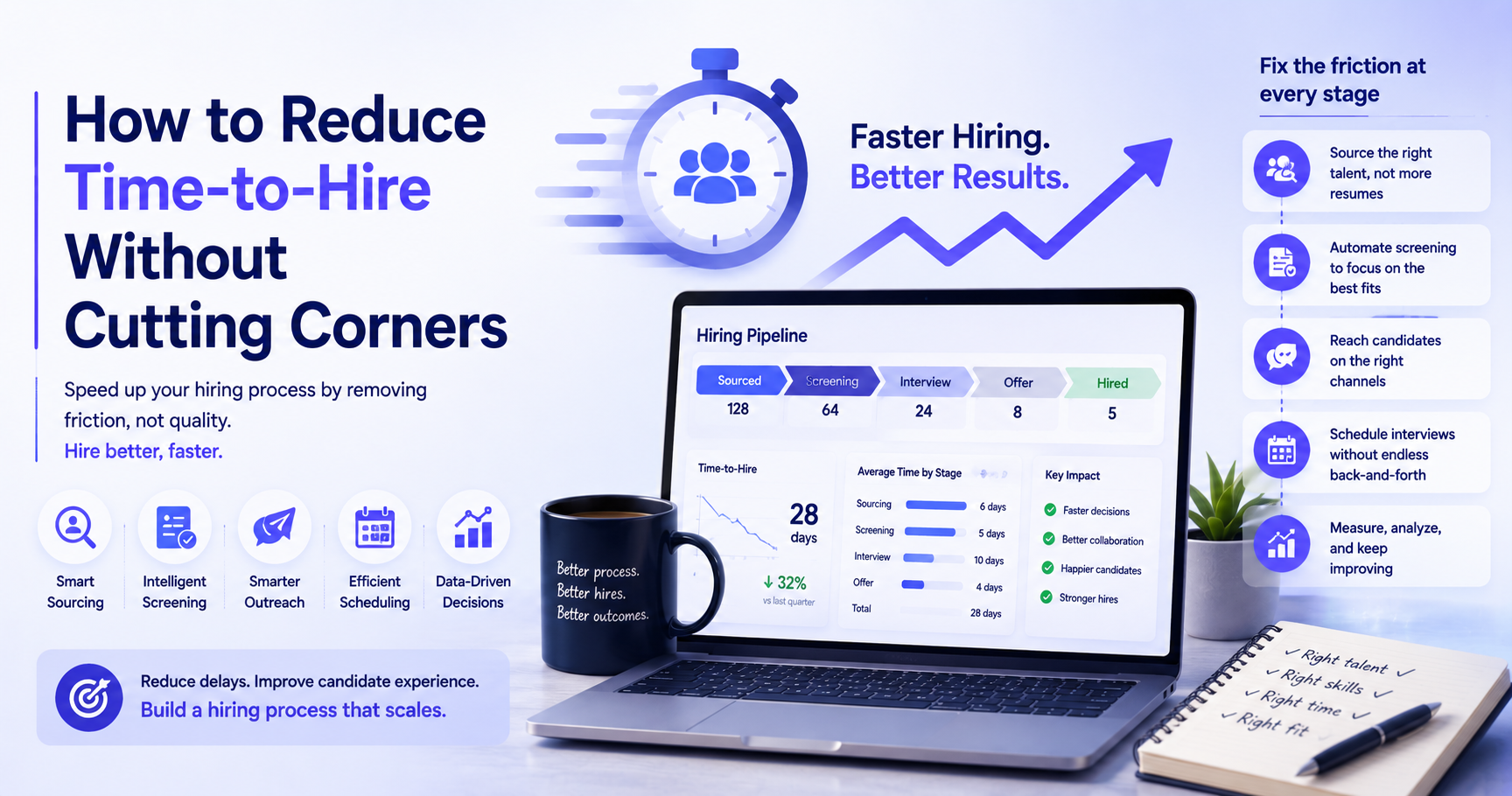
"We need to hire faster" is one of the most common requests a recruiter hears from a hiring manager — and one of the most frustrating, because it's rarely followed by "and here's the extra support you'll need to actually do that." Left as pressure alone, "hire faster" usually just means "cut some step of the process," which quietly increases the risk of a bad hire.
The good news is that most of the time lost in hiring isn't in the parts that require careful judgment — it's in avoidable friction: waiting for calendar replies, chasing feedback, re-explaining a role to yet another sourced candidate who wasn't actually a fit.
Fix the friction, and you can genuinely speed things up without touching the parts of the process that protect hiring quality.
This post breaks down where time-to-hire actually gets lost, with practical fixes for each stage.
Time-to-hire vs. time-to-fill: know which one you're actually measuring
These two metrics get used interchangeably, but they measure different things, and mixing them up leads to solving the wrong problem.
- Time-to-fill is measured from when a role is opened (or posted) to when it's filled. It includes how long a role sits open before a recruiter even starts sourcing — often influenced by internal approval processes, budget sign-off, or simply prioritization against other open roles.
- Time-to-hire is measured from when a candidate first enters your pipeline (applies, gets sourced, or is referred) to when they accept an offer. It's a cleaner measure of your actual process efficiency, since it starts once a real candidate is in motion.
If your time-to-fill is high but time-to-hire is reasonable, your bottleneck is probably upstream — role approval, budget sign-off, or simply not starting sourcing quickly enough. If time-to-hire itself is high, the problem is inside your process, and that's what this post focuses on.
Where time actually gets lost (and it's rarely where people assume)
Ask a hiring manager where time gets lost in hiring, and they'll often guess "not enough good candidates." That's sometimes true, but in a lot of processes, the bigger drains are more mundane:
1. Sourcing takes too long because the funnel is too shallow or too broad
Both extremes cost time. A funnel that's too narrow means constantly going back to source more candidates because too few pass screening. A funnel that's too broad means a recruiter drowning in applications that were never going to be a fit, spending hours screening people who should have been filtered out earlier.
Fix: Tighten the job description and screening criteria before sourcing starts, not after a pile of mismatched applications has already arrived. If sourcing relies heavily on keyword search, expect to catch a lot of near-misses — matching on actual skills and experience context, rather than exact job-title keywords, produces a smaller but more relevant funnel from the start. This is the core idea behind context-aware sourcing tools like Recruitkar's AI candidate discovery, which matches against a job description directly rather than requiring a recruiter to guess the right search terms.
2. Screening becomes a bottleneck when it's entirely manual
Reviewing every resume by hand doesn't scale, and it's where recruiter fatigue creeps in — decision quality on resume 80 is rarely as sharp as on resume 8.
Fix: Use automatic scoring against clear, role-specific criteria to do the first pass, and reserve manual review for the shortlist it produces. This isn't about removing human judgment — it's about applying it where it actually matters, on a smaller, pre-filtered set of candidates, rather than spreading it thin across everyone.
3. Outreach stalls because candidates don't respond to the first message, or the first channel
A message sent once, into an inbox a candidate doesn't check often, can sit unanswered for days — and a recruiter waiting on that reply before moving forward is losing time for no good reason.
Fix: Don't rely on a single channel. Email response rates have been declining for years, especially with passive candidates. In India specifically, WhatsApp outreach tends to get read (and answered) far faster than email, simply because it's a channel people actually check throughout the day. Sequencing outreach across channels — rather than waiting out a single unanswered email — meaningfully cuts the dead time between "candidate identified" and "candidate engaged."
4. Interview scheduling eats days through pure back-and-forth
This is one of the most common, most fixable sources of delay: "does Tuesday at 3pm work?" — "no, how about Wednesday?" — "let me check with the panel" — repeated across five candidates and three interviewers, often over email.
Fix: Calendar-integrated scheduling that shows real availability and lets candidates pick a slot directly removes almost all of this friction. Whether it's a simple shared calendar link or a built-in scheduler like Recruitkar's interview scheduling, which connects Google/Outlook calendars directly into Meet, Zoom, or Teams, the underlying fix is the same: stop scheduling by email thread.
5. First-round interviews create a scheduling bottleneck of their own, especially at volume
For high-volume roles, the sheer number of first-round interviews needed can be a bottleneck on its own — there are only so many hours in a recruiter's week to conduct live first-round conversations.
Fix: Asynchronous AI video interviews let candidates complete a structured first round on their own schedule, which a recruiter can review (or that gets auto-scored) without needing to coordinate a live call for every single candidate. This isn't right for every role — nuanced, senior positions usually still benefit from a live conversation early on — but for high-volume or entry-level hiring, it removes a genuine scheduling constraint. Recruitkar's AI video interviews support this pattern, alongside free human scheduling for roles where a live first conversation matters more.
6. Feedback collection drags because it's scattered across people and channels
A hiring decision often waits on three or four people's feedback, and if that feedback lives in separate emails, Slack messages, or verbal comments that never get written down, decisions stall waiting for someone to consolidate it.
Fix: Centralize feedback directly on the candidate's record in your pipeline, and set a clear expectation (e.g., 24–48 hours) for interviewers to submit it. A shared ATS pipeline that every interviewer can access directly — rather than relaying feedback through the recruiter as a middleman — removes a surprising amount of delay here.
7. Offer approval takes longer than the entire interview process combined
This one is rarely about recruiting technology at all — it's usually an internal approval chain (compensation sign-off, multiple layers of management approval) that was never designed with hiring speed in mind.
Fix: This is worth raising directly with leadership, not solving with a tool: map out exactly how many approvals an offer needs and how long each typically takes. In a lot of organizations, this single stage is quietly the largest chunk of time-to-hire, and it's entirely within the company's control to fix by pre-approving compensation bands or reducing approval layers for standard offers.
8. Rejections pile up without being communicated, quietly damaging your funnel for next time
This doesn't slow down the current hire, but it costs you later: candidates left in limbo — never told they weren't moving forward — are less likely to reapply, less likely to refer others, and more likely to leave a public review reflecting a poor experience. That shrinks your future funnel and makes the next role slightly harder to fill quickly.
Fix: Build rejection communication into the process itself rather than treating it as optional cleanup. Even a brief, templated message sent promptly is better for long-term funnel health than silence, and automated status updates through whichever channel a candidate actually responds on (email or WhatsApp) mean this doesn't have to consume additional recruiter time to do consistently.
What NOT to cut to save time
Since the request "hire faster" so often gets translated into "skip a step," it's worth being explicit about which shortcuts create real risk:
- Skipping structured interview questions to "save time" tends to produce less comparable, more gut-feel decisions — which often costs more time later if it leads to a bad hire and a re-opened role.
- Reducing the number of interviewers to one removes a natural check against individual bias, even if it speeds up scheduling.
- Rushing reference checks or skipping them entirely is a common time-saving shortcut that occasionally comes back to bite a team badly.
- Making an offer without clear internal alignment (e.g., a hiring manager and a skip-level who disagree) just moves the conflict to after the offer is out, which is a worse time to have it.
The goal isn't fewer steps — it's less friction and waiting between steps that all still need to happen.
A practical starting point: audit your own funnel
Rather than assuming where your bottleneck is, it's worth actually measuring it. Pull the last 10–15 hires and calculate the average number of days spent in each stage: sourcing to first contact, first contact to screening, screening to first interview, first interview to offer, offer to acceptance. Whichever stage is disproportionately long relative to the others is where to focus first — fixing a bottleneck that isn't actually your bottleneck won't move the overall number much.
A few numbers worth benchmarking against, if you don't already track this: interview scheduling frequently accounts for several days of pure back-and-forth per candidate when done manually over email, and outreach on unresponsive channels can silently add a week or more of waiting before a recruiter moves on to the next candidate. If your own numbers are meaningfully worse than that in any single stage, that's usually your highest-leverage fix.
Where technology helps, and where it genuinely doesn't
It's worth being honest about the limits here, since not every stage benefits equally from automation:
- Sourcing and outreach are where technology tends to help the most — these are high-volume, repetitive tasks where consistency and speed compound quickly.
- Screening benefits significantly, but only up to the point of producing a shortlist — the actual evaluation of a shortlisted candidate still benefits from human judgment.
- Interview scheduling is almost entirely a solvable logistics problem — there's very little reason for this stage to take days in 2026.
- The interview itself (beyond a structured first-round screen) is the stage where speed should matter least. A rushed panel interview to "save a day" is rarely worth the risk of a worse hiring decision.
- Offer approval is usually an internal-process problem, not a technology problem, and no recruiting tool will fix a compensation-approval chain that requires four separate sign-offs.
Recognizing which category a given delay falls into is often the fastest way to figure out whether you need a new tool, a process change, or simply a conversation with leadership about internal approval chains.
What "faster" actually looks like when it's done well
It's worth painting a concrete picture, since "reduce time-to-hire" can otherwise stay abstract. A well-run process for a mid-level role might look like this: a tightened job description goes out and context-matched sourcing surfaces a strong shortlist within the first couple of days, rather than a recruiter manually reviewing hundreds of unfiltered applications over a week. Outreach goes out across two channels instead of one, with a fallback message on day two if the first goes unanswered. Interview slots are offered directly through a scheduling link instead of an email back-and-forth, collapsing what used to take three or four days into same-day booking. Interviewer feedback is due within 48 hours and logged directly against the candidate record, so a hiring decision doesn't stall waiting for someone to remember to reply to a Slack thread. None of this required cutting a single stage of evaluation — it just removed the waiting between them.
A simple framework for prioritizing fixes
Once you've audited your funnel and know where time is actually being lost, prioritize fixes using two questions: how much time does this stage cost, and how much control do you actually have over it?
- High time cost, high control (e.g., manual interview scheduling, single-channel outreach) — fix these first. They're usually the fastest wins.
- High time cost, low control (e.g., a slow internal approval chain) — these need a conversation with stakeholders outside recruiting, not a new tool. Flag them explicitly rather than quietly absorbing the delay.
- Low time cost, high control — worth fixing eventually, but not where to spend your first effort.
- Low time cost, low control — usually not worth the political capital to address right now.
This keeps effort focused on the fixes that actually move the number, instead of optimizing a stage that was never the real bottleneck.
The bottom line
Reducing time-to-hire genuinely doesn't have to mean lowering your bar. Almost all of the time lost in a typical hiring process comes from friction — waiting on replies, manually coordinating calendars, chasing feedback, sourcing too broadly or too narrowly — not from the parts of the process that actually protect hiring quality, like structured interviews or thoughtful reference checks. Fix the friction first. It's very often where most of the delay was hiding, and it's the part you can fix without asking anyone to compromise on who gets hired.