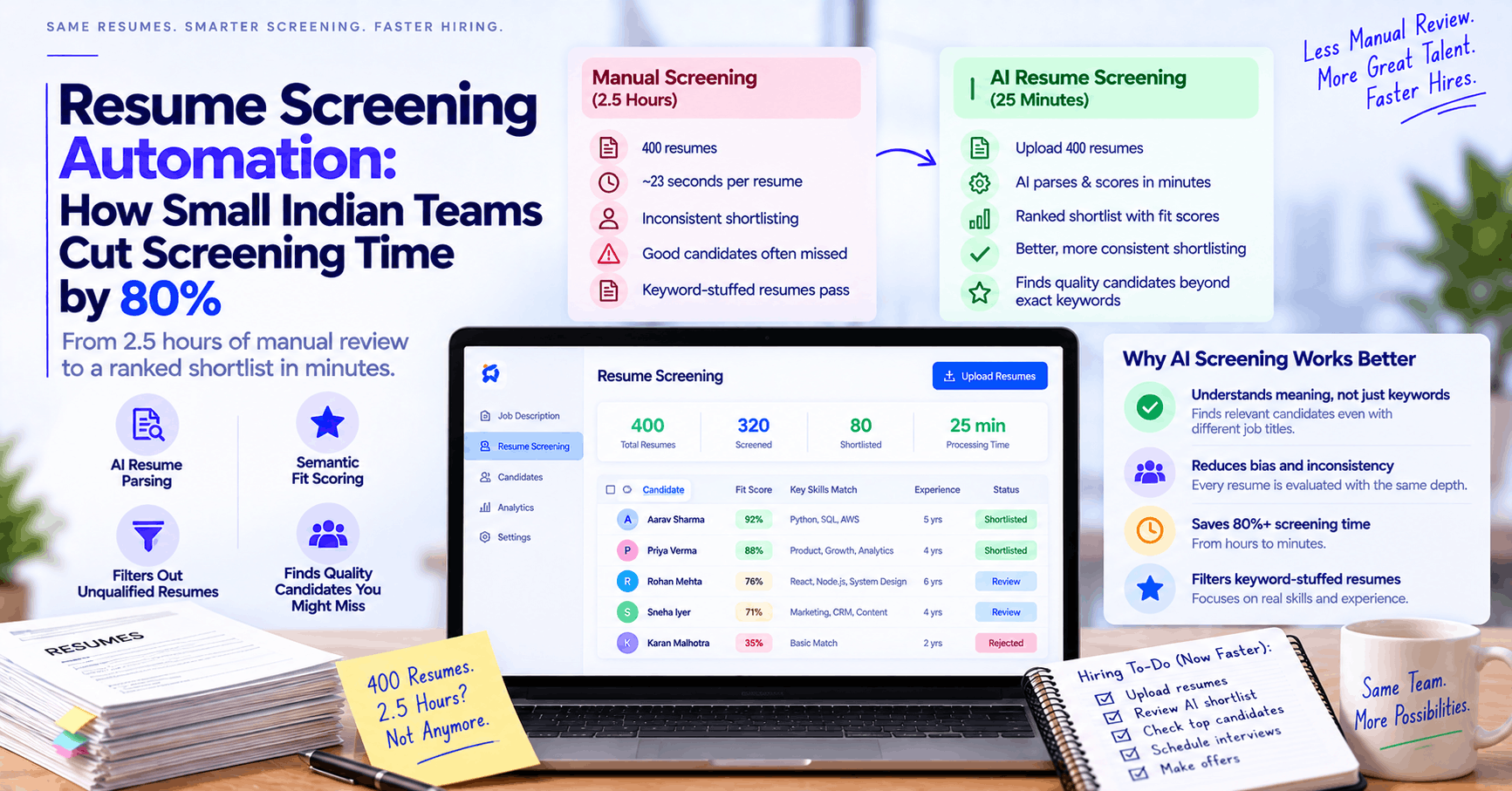
The average recruiter in India spends 23 seconds on a resume before deciding to advance or reject a candidate — and when 400 resumes arrive for one role, that's still 2.5 hours of manual review before a shortlist exists. The problem isn't the time; it's the inconsistency. Resume 1 gets careful attention; resume 350 gets a tired glance. RecruitKar's bulk resume parsing and AI scoring reads every resume in the same depth, scores each one against the specific requirements of the role, and produces a ranked shortlist in minutes rather than hours — so a recruiter's 2.5 hours of review time becomes 25 minutes of shortlist validation.
This post explains why traditional keyword-matching resume screening fails in both directions — rejecting good candidates and passing bad ones — and how semantic AI scoring changes the equation, with a practical implementation guide for small Indian recruiting teams.
The core problem with keyword-based resume screening
Most ATS platforms filter resumes using keyword matching: they scan the document for specific words or phrases from the job description and score the resume higher if more of those words are present. It's fast, it's automated, and it consistently produces two failure modes that keyword-matching proponents rarely acknowledge.
Failure mode 1: Great candidates get filtered out
A highly qualified candidate who spent five years as a "Growth Lead" at a startup, doing exactly the work a "Marketing Manager" job description requires, gets low scores from a keyword filter because her title and the expected title don't match. A "Data Analyst" who has been doing data engineering work for two years doesn't score well on a "Data Engineer" search because the job title in her resume doesn't match the title in the search.
The candidate is qualified. The keyword filter doesn't know that, because keyword filters don't understand meaning — they match strings.
Failure mode 2: Keyword-stuffed resumes get through
Candidates who know how ATS screening works — and there are entire communities sharing tips on how to beat keyword filters — write resumes that repeat every term from the job description, sometimes hiding keywords in white text on a white background. These resumes score high in keyword-matching systems regardless of whether the candidate can actually do the job.
The keyword filter is being played, not by candidates with bad intentions in most cases, but by a population that has correctly learned how the system works and has adapted to it.
Why this matters more for small Indian teams
A large enterprise with a dedicated sourcing team can absorb bad filtering — they have the capacity to review large shortlists or run multiple rounds of sourcing if the first round misses good candidates. A team of one or two recruiters at a startup or growing company cannot.
When a small team uses keyword-based filtering and it misses the right candidates, the role either stalls (waiting for better applications that aren't coming) or fills with a suboptimal candidate. Both outcomes are more costly for a small team than for a large one, precisely because small teams have less capacity to absorb and correct those mistakes.
How semantic AI resume scoring works differently
Semantic scoring doesn't match strings — it understands meaning. Where a keyword filter asks "does this resume contain the word 'project manager'?" a semantic scorer asks "does this person's described experience reflect the competencies of a project manager?"
The technical mechanism involves representing both the job description's requirements and the candidate's experience as meaning vectors in a high-dimensional space, then measuring how similar they are — an approach called semantic similarity scoring. Practically, this means:
- Growth Lead vs Marketing Manager: A "Growth Lead" who ran marketing campaigns scores high for a Marketing Manager role because the underlying work described is semantically similar, even though the title doesn't match.
- Software Engineer vs Full-Stack Developer: A "Software Engineer" who lists React, Node.js, and PostgreSQL in their experience matches well against a "Full-Stack Developer" JD because the skills are semantically related, even if the exact phrasing differs.
- Keyword-stuffed resumes score lower: A candidate who has keyword-stuffed a resume without genuine experience scores lower than one whose described projects and accomplishments reflect the role's actual requirements.
The score reflects what a thoughtful senior recruiter would conclude from reading the resume in full — not which keywords were present.
What AI resume scoring actually produces
A ranked shortlist, not a binary pass/fail
Where keyword filters produce a binary result — either the resume passes the minimum keyword threshold or it doesn't — AI scoring produces a ranked list. A recruiter reviewing a ranked list of 25 candidates from 400 applications is doing meaningfully different work than one reviewing a binary-filtered list: they're making relative judgments ("is candidate 8 actually stronger than candidate 3 for this specific role?") rather than reviewing candidates in the arbitrary order they happened to apply.
Consistent evaluation of every resume
Resume 400 gets exactly the same evaluation as resume 1 — the same scoring rubric applied with the same depth of reading. The fatigue effect that degrades manual review quality over a long screening session doesn't apply.
A documented scoring rationale
AI resume scoring systems produce scores with explanations — which criteria were met strongly, which were weak, which were missing — rather than a gut-feel rating with no audit trail. This is both operationally useful (a recruiter can quickly understand why a candidate ranked where they did) and defensible if a screening decision is ever questioned.
Faster time to shortlist
The actual efficiency gain is less about the AI being smarter per resume and more about what it enables: reviewing 25 ranked candidates rather than 400 unranked ones. A recruiter who would spend 2.5 hours reviewing 400 resumes manually spends 25–30 minutes validating a pre-ranked shortlist of 25 — with better results, because the pre-ranking was applied consistently rather than inconsistently.
Implementing resume screening automation: a step-by-step guide
Step 1: Write a JD that gives the AI meaningful signal
AI resume scoring is only as good as the job description it's scoring against. A vague JD ("looking for a dynamic self-starter with strong communication skills") gives the scoring system almost nothing to work with. A specific JD ("3+ years managing paid acquisition campaigns across Google and Meta, with hands-on experience optimising for CAC in a D2C context") gives it detailed signal to match against.
Before uploading a resume pile, review the JD with one question: does this JD describe specific, verifiable skills and experience, or does it describe personality traits and generic qualities? Specific skills and experience is what AI resume scoring can evaluate against. Personality traits and generic qualities are what gets you an inconsistent ranking.
Step 2: Upload the resume pile to the scoring system
Bulk resume parsing and AI scoring on RecruitKar accepts PDF, DOCX, and a range of other common resume formats in bulk — drag and drop the full application pile, or connect the job board integration and import applications automatically as they arrive. Each resume is parsed and scored against the active JD automatically.
Step 3: Review the ranked shortlist, not the raw pile
Set a working threshold — review the top 20–30% of ranked candidates in full — rather than reviewing every resume. Spot-check 5–10 candidates below your threshold periodically to confirm the ranking is working as expected. If a candidate who looks strong on a quick read consistently appears below the threshold, check whether the JD is capturing the right criteria.
Step 4: Add shortlisted candidates to the pipeline
Shortlisted candidates move from the resume pile into the active visual ATS pipeline, where they're tracked through screening, interviews, and offers. The scoring data from their resume review travels with them — a recruiter interviewing a candidate two weeks later can see exactly why they were shortlisted, not just that they were.
Step 5: Adjust the scoring rubric after the first round
The first AI screening result for a new role type is a starting point, not a final state. After the first round, compare which shortlisted candidates actually progressed well through interviews against their original AI scores. Discrepancies — candidates who scored high but interviewed poorly, or scored low but were manually added and performed well — point to criteria in the JD that don't accurately reflect what the role actually requires. Adjust the JD and rescore.
Common objections, answered
"We'll miss good candidates who don't write resumes well"
Semantic scoring reduces (though doesn't eliminate) the penalty for resumes that describe real experience in non-standard ways — it's less sensitive to phrasing than keyword matching. But it's worth being honest: a candidate who writes a genuinely poor resume will score lower than the quality of their experience warrants, under any automated system. The practical fix isn't to avoid automation — it's to complement automated scoring with other sourcing channels (direct sourcing, referrals) that don't depend on the candidate's resume quality for discovery.
"The AI might have biases built in"
This is a legitimate concern. Semantic AI scoring systems learn from data, and if the data they were trained on reflects historical biases — certain schools, companies, or phrasing styles being associated with "better" candidates — the model can learn and perpetuate those associations. The practical safeguard is treating AI scores as a prioritisation tool rather than a hiring decision: a human recruiter reviews the ranked shortlist and makes the actual advancement call. A score that informs human judgment is meaningfully different from a score that replaces it.
"Our team is too small to set this up"
The setup for AI resume scoring in a modern platform is considerably less technical than it sounds — it's typically uploading resumes and pointing the system at the JD. The "setup" that matters more is getting the JD right, which a recruiter is doing anyway. The technical overhead of bulk upload and AI scoring adds minutes to the process, not hours.
The Naukri and Indeed integration angle
For Indian recruiters, applications typically arrive through Naukri and Indeed rather than a single careers page. RecruitKar's 1-click job board import pulls applications directly from Naukri and Indeed into the scoring system as they arrive — so the ranked shortlist is continuously updated as applications come in, rather than requiring a manual export/import step at the end of the application window.
This is practically significant: a role posted on Naukri that receives 50 applications on Day 1 and 150 more by Day 5 can have a continuously updating ranked shortlist rather than a batch at the end — allowing a recruiter to begin outreach to strong early applicants while the posting is still receiving new ones.
What 80% time reduction actually means in practice
The 80% reduction in screening time isn't a marketing claim — it's a math exercise. A recruiter reviewing 400 resumes manually at 3–4 minutes of genuine attention per resume (not 23 seconds, but real consideration) takes 20–27 hours over several working days. The same recruiter reviewing a top-25 AI-ranked shortlist with 10 minutes per candidate takes 4–5 hours. That's an 80–85% reduction in review time, with better consistency and a documented scoring rationale as a side benefit.
For a small team where one recruiter manages multiple open roles simultaneously, compressing screening from 20+ hours per role to 4–5 hours per role is the difference between a team that can handle three open roles simultaneously and one that can handle eight.
Frequently asked questions
What file formats does AI resume screening handle? PDF and DOCX are universally supported across all AI resume parsing tools. Some platforms also handle DOC, RTF, and plain text. The practical consideration for Indian hiring teams: a meaningful share of resumes received through Naukri arrive in formats that aren't always consistently structured — a parser that handles formatting variation gracefully (extracting experience correctly even from non-standard layouts) performs better in practice than one optimised for cleanly formatted resumes only. Test with a real batch of Indian job-seeker resumes, not a demo dataset.
How does AI resume scoring handle resumes in Hindi or regional languages? Most AI resume parsing and scoring systems are primarily optimised for English-language resumes, including the semantic similarity models that power fit scoring. Resumes submitted in Hindi or regional languages typically need to be in English or bilingual for scoring to work reliably. This is worth being explicit about in your job posting if you're screening for roles where candidates might submit regional-language resumes — either accepting them and reviewing them manually, or specifying that applications should be submitted in English.
Can AI resume scoring replace the human review entirely? It shouldn't, and the most defensible implementations don't treat it this way. AI scoring should prioritise which resumes a human reviews, not decide which candidates advance without human review. The liability, fairness, and practical quality arguments all point in the same direction: keep a human making advancement decisions, with AI scoring informing those decisions rather than replacing them.
What's the difference between resume parsing and resume scoring? Parsing extracts structured data from a resume — name, contact, experience history, education, skills — turning an unstructured document into searchable, comparable fields. Scoring evaluates that structured data (and sometimes the raw text) against a role's requirements to produce a fit ranking. Most modern AI resume tools do both: parsing to make the data usable, scoring to make the pile manageable. The scoring step is where the meaningful quality difference lies — a system that parses accurately but scores on keyword matching is less useful than one that scores semantically.
How does this work alongside sourcing tools that find candidates proactively? Resume screening automation handles inbound applications — candidates who have already applied. Discover candidates with AI handles outbound sourcing — finding candidates who haven't applied yet, based on a JD. They address different stages of the funnel and work together rather than competing: outbound sourcing builds the candidate pool, and resume screening efficiently processes the inbound pipeline. Both feed into the same ATS pipeline for unified tracking.
Upload your resume pile and get instant candidate match rankings on RecruitKar. Drop in 400 resumes, get a ranked shortlist in minutes — bulk resume parsing and AI scoring included in every plan.