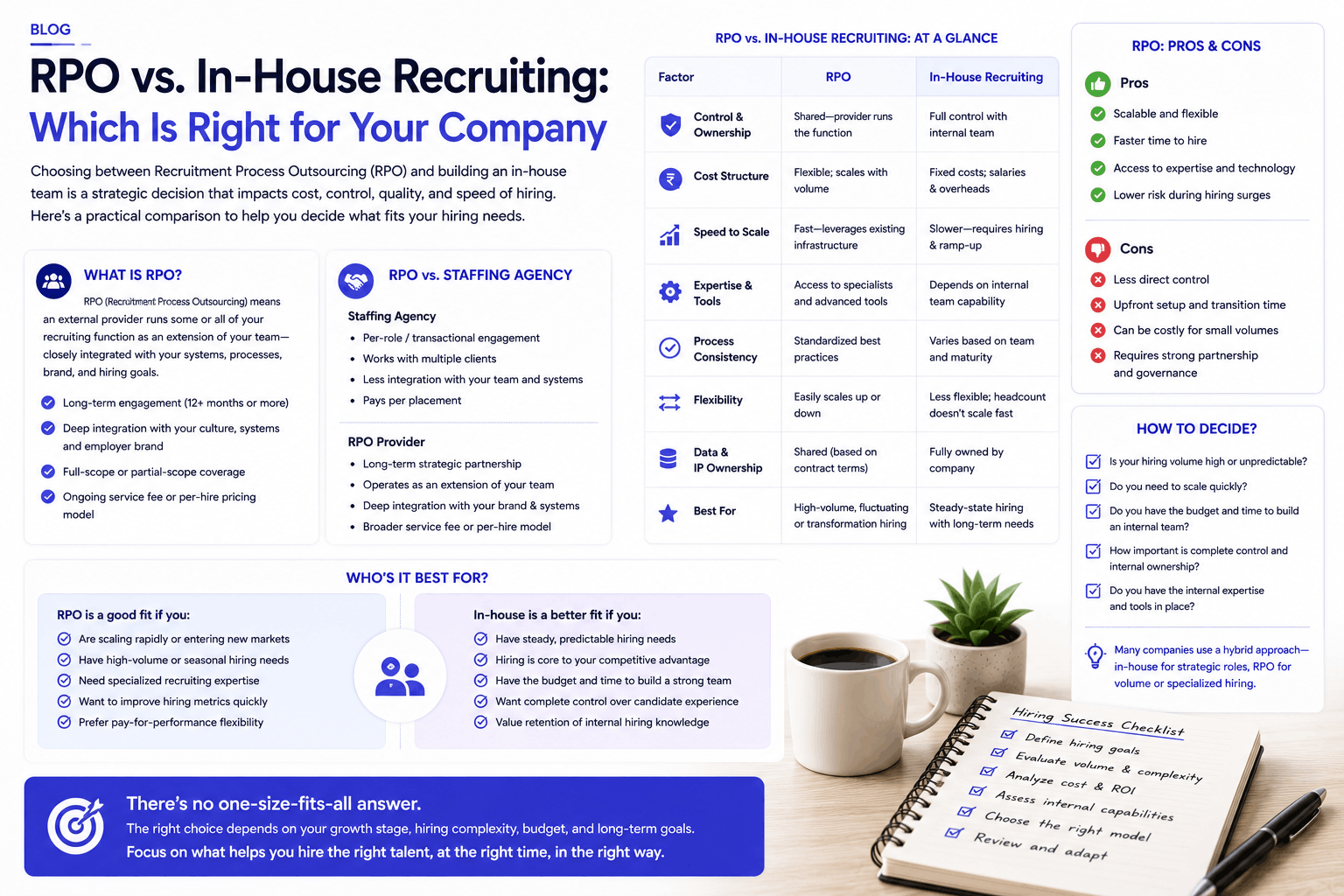
At some point, most growing companies face the same question: should hiring stay entirely internal, or does it make sense to bring in an outside partner to run some or all of it? The answer isn't universal — it depends on hiring volume, how predictable that volume is, budget, and how much control a company wants over the day-to-day hiring process. This post breaks down what RPO (Recruitment Process Outsourcing) actually involves, how it differs from simply using a staffing agency, and a practical framework for deciding which model — or which mix of both — actually fits your situation.
What RPO actually is
Recruitment Process Outsourcing means a company hands over some or all of its recruiting function to an external provider, who effectively operates as an extension of the internal team — often embedded closely enough that candidates and hiring managers may not immediately realize they're working with an outside partner. This is meaningfully different from a traditional staffing agency relationship, where an agency is brought in on a transactional, per-role basis, competing with other agencies for placements.
RPO engagements typically involve:
- A longer-term contract (often 12+ months, sometimes multi-year) rather than a per-role transaction.
- Deep integration with the client's systems, employer brand, and hiring processes, rather than working at arm's length.
- Either full-scope coverage (the RPO provider owns the entire recruiting function) or partial-scope coverage (the provider handles specific stages — sourcing, screening, or a specific business unit — while the client retains the rest internally).
- Pricing structured around a broader service fee or per-hire model tied to the ongoing relationship, rather than a one-off placement fee per role.
RPO vs. staffing agency: the distinction that actually matters
These two get conflated often enough that it's worth being explicit about the difference, since the decision-making considerations are genuinely different for each:
A staffing agency typically works multiple clients simultaneously, is usually engaged on a per-role or contingency basis, and there's often less deep integration with any single client's internal culture, systems, or brand. The relationship is more transactional — you post a role, the agency sources candidates, you pay per placement.
An RPO provider typically works more deeply with one client (or a smaller number), effectively running that client's recruiting function — sometimes indistinguishably from an internal team, down to using the client's own employer branding and communicating with candidates under the client's name — over a sustained, longer-term engagement.
If what you actually need is help filling a handful of specific, hard-to-source roles, a staffing agency relationship is usually the better and more cost-effective fit. If what you need is a sustained, ongoing recruiting capability without building it fully in-house, RPO is the more appropriate model.
What building an in-house team actually involves
The alternative to outsourcing is building internal recruiting capability — hiring recruiters, sourcers, and coordinators as employees, building internal processes and tooling, and retaining full day-to-day control over how hiring happens.
This has real, well-understood advantages: recruiters who work exclusively for your company develop deep familiarity with your culture, hiring managers, and specific role requirements over time in a way that's harder for an external partner (even a well-integrated RPO provider) to fully replicate. It also keeps hiring capability as a retained, internal asset rather than something that leaves with a vendor relationship if it ends.
The trade-offs are equally real: building an internal team requires meaningful upfront investment (hiring the recruiters themselves, building tooling and process, ramping new hires up), and internal capacity doesn't flex easily — a team sized for steady-state hiring can become a bottleneck during a sudden hiring surge, or sit underutilized during a slow period, since headcount doesn't scale up and down as fluidly as an outsourced arrangement can.
A practical comparison
RPO
In-house recruiting
Best for — Sustained hiring needs without wanting to build full internal capability, or scaling quickly without long-term headcount commitment.
Best for — Companies with steady, predictable hiring volume who value deep internal familiarity and full process control.
Flexibility with volume — High — provider can typically flex capacity up or down more easily than internal headcount.
Flexibility with volume — Lower — internal team size is a fixed cost that doesn't flex quickly.
Cultural/institutional knowledge — Builds over time, but generally slower than a fully internal team, and can be lost if the engagement ends.
Cultural/institutional knowledge — Builds naturally and stays retained within the company.
Upfront investment — Lower — no need to hire and ramp an internal team from scratch.
Upfront investment — Higher — requires hiring, tooling, and process-building before full capability exists.
Control over day-to-day process — Shared, defined by contract terms.
Control over day-to-day process — Full, direct control.
Typical engagement length — Longer-term contract, built for sustained partnership.
Typical engagement length — Ongoing, indefinite (employees, not a vendor contract).
When RPO tends to make sense
Rapid, uncertain scaling.
A company entering a high-growth phase, or opening a new market/business line with hiring needs that are hard to predict precisely, often benefits from RPO's ability to flex capacity without committing to a large internal headcount that might not be needed at the same scale a year later.
Filling a capability gap temporarily or permanently.
A company without existing internal recruiting expertise — common for smaller or newer companies — can get access to established process and expertise faster through RPO than by building an internal function from scratch.
High-volume, cyclical hiring needs.
Seasonal hiring surges (retail around major shopping periods, campus hiring cycles) are often a strong fit for RPO, since the volume need is real but not necessarily sustained year-round at the same intensity.
Wanting to focus internal resources elsewhere.
Some companies deliberately choose to keep recruiting a core internal function reserved for senior or highly strategic roles, while outsourcing higher-volume, more standardized hiring to an RPO partner — a hybrid approach that's increasingly common rather than an all-or-nothing choice.
When building in-house tends to make more sense
Steady, predictable hiring volume.
If hiring needs are relatively consistent year over year, the ongoing cost of an internal team is often more predictable and, over a longer horizon, more cost-effective than a sustained RPO engagement.
Hiring quality that depends heavily on deep cultural or technical fit.
For roles where evaluating fit requires genuinely deep familiarity with internal culture, technical nuance, or team dynamics, an internal recruiter who's been embedded in the company for years often has an advantage that's harder for an external partner to replicate quickly, however well-integrated.
Wanting full, direct control over candidate experience.
Since recruiters are often a candidate's first meaningful interaction with a company, some organizations prefer keeping that experience fully in-house rather than mediated, even partially, by an external partner's own processes and tooling.
Building recruiting as a long-term strategic capability.
Companies that see recruiting expertise itself as a competitive advantage — not just an operational function — tend to invest in building and retaining that capability internally rather than treating it as something to outsource.
A hybrid approach is increasingly common, and often the most practical
Few companies are purely one model or the other in practice. A common, pragmatic pattern: a smaller internal team handles core, strategic, or senior hiring where deep cultural fit and long-term relationship-building matter most, while an RPO partner or staffing agencies handle higher-volume, more standardized roles, or provide surge capacity during periods of unusually high hiring need. This lets a company retain institutional knowledge and control where it matters most, while accessing flexible capacity where volume and predictability make that the more efficient choice.
What to actually evaluate before deciding
Your hiring volume trajectory, honestly assessed.
Is volume genuinely predictable and steady, or is it likely to swing significantly based on funding, business cycles, or market conditions? Volatility favors flexible models (RPO, staffing agencies); predictability favors internal investment.
Total cost over a realistic time horizon, not just year one.
RPO often looks cheaper upfront (no hiring and ramp-up cost for an internal team), but over a multi-year horizon, a well-built internal team can become more cost-effective, particularly at higher sustained volumes. Model this out honestly rather than comparing only near-term costs.
How much control over candidate experience actually matters for your brand.
For companies where the hiring process itself is a meaningful part of employer brand and candidate perception, keeping more of the process in-house — or being very selective about which parts get outsourced — tends to matter more.
Whether you're solving a capacity problem or a capability problem.
If the issue is simply not having enough hands to handle current volume, temporary RPO or agency support might resolve it without a permanent structural change. If the issue is a genuine lack of internal recruiting expertise or process maturity, that's a different problem, and outsourcing without eventually building internal capability can leave a company perpetually dependent rather than solving the underlying gap.
Common misconceptions worth clearing up
"RPO means losing control over who gets hired." In a well-structured engagement, the client typically retains final hiring decisions — the RPO provider manages sourcing, screening, and process, but offer decisions and cultural fit assessments usually still involve the client's own hiring managers. The degree of control retained depends entirely on how the contract is scoped, which is worth negotiating explicitly rather than assuming.
"In-house is always cheaper in the long run." This is often true at steady, predictable volume, but it's not a universal rule — the cost comparison depends heavily on actual hiring volume, how long it takes to build internal capability to full productivity, and how much volatility exists in hiring needs. A company that overbuilds internal capacity for a hiring surge that doesn't materialize can end up with a more expensive outcome than a flexible RPO arrangement would have produced.
"RPO providers don't understand our culture the way an internal team would." This is a legitimate concern early in an engagement, but it's not necessarily permanent — well-run RPO relationships typically involve a deliberate onboarding and knowledge-transfer period specifically to build this familiarity over time, and mature RPO engagements often reach a level of cultural fluency that surprises companies who assumed this gap was unbridgeable.
"Switching between models later is difficult." It's certainly not trivial, but companies do shift between in-house, RPO, and hybrid models as their needs evolve — a company that scaled quickly with RPO support during a growth phase might later build more internal capability once volume stabilizes, and vice versa. Keeping candidate data and process documentation in a system that isn't tightly coupled to one specific vendor or team structure makes this kind of transition considerably less disruptive when it happens.
A short decision checklist
- Is your hiring volume genuinely predictable, or does it swing significantly with business cycles, funding, or seasonal demand?
- Have you honestly modeled total cost over a 2–3 year horizon, not just the first year, for both options?
- How much does direct control over candidate experience matter for your specific employer brand?
- Are you solving a temporary capacity gap, or a longer-term capability gap that outsourcing alone won't fully resolve?
- Would a hybrid split — internal for strategic roles, external for high-volume or cyclical hiring — actually fit your situation better than an all-or-nothing choice?
Tools that support either model
Regardless of which model a company chooses, the underlying tooling question is similar: whoever is doing the recruiting — internal team, RPO partner, or a hybrid of both — needs a consolidated way to source, communicate with, and track candidates without the process fragmenting across disconnected systems. A shared ATS pipeline that both an internal team and an external partner can access, alongside consistent sourcing and outreach tooling, reduces the friction that often comes with transitioning between models or running a hybrid approach — a company doesn't need to rebuild its entire hiring infrastructure just because the mix of who's actually doing the recruiting shifts over time.
The bottom line
There's no universally correct answer to RPO versus in-house recruiting — it depends on how predictable your hiring volume actually is, how much upfront investment you're willing to make for long-term internal capability, and how much control over candidate experience genuinely matters for your specific situation. Many companies land on a hybrid model rather than an all-or-nothing choice, and that's often the most pragmatic answer: keep strategic, high-stakes hiring internal where deep familiarity matters most, and use flexible external capacity where volume and predictability make that the more sensible trade-off.