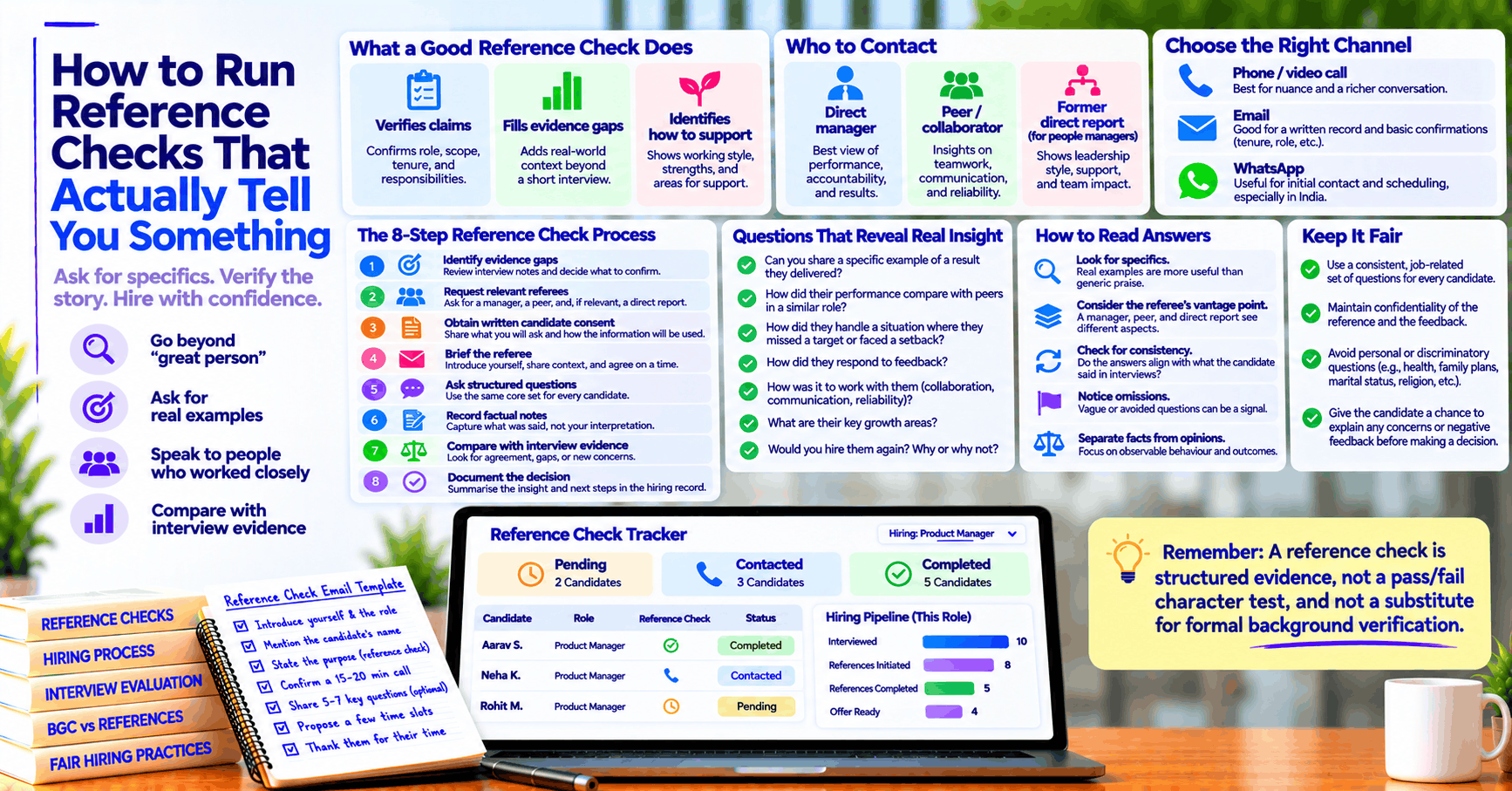
A useful reference check comes down to three things: ask for specifics instead of opinions, speak to people who worked closely with the candidate, and compare every answer against what the candidate told you in interviews. Done this way, a reference call takes about 20 minutes and can confirm or challenge your hiring decision. Using RecruitKar's email outreach to send consistent reference requests, and tracking replies alongside each candidate's record, keeps the process fast, fair, and documented. This guide covers when to run checks, who to call, which reference check questions to ask, and how to interpret the answers.
What a Reference Check Is Actually For
Many teams treat reference checks as a formality. The candidate supplies two friendly names, the referee says "great person, would hire again," and the recruiter ticks a box. That tells you almost nothing.
A good reference check does three jobs:
- Verifies claims. Did the candidate hold the role, scope, and tenure they described?
- Fills gaps in your evidence. Interviews are short and performed. A former manager has seen months or years of real behaviour.
- Shows how to set the person up for success. Even a strong hire has working-style needs. A good reference tells you how this person does their best work and where they need support.
A reference check is not a background verification. Background verification confirms identity, employment, education, and similar records through formal processes. A reference check is a conversation about performance and working style. The two complement each other, and neither replaces the other. Treating a reference call as a pass/fail test for a candidate's character is also a mistake. It is one input among several.
When to Run Reference Checks
The timing depends on your hiring process, but a few principles hold in most Indian hiring contexts.
Run them late, but not last-minute. The ideal point is after the final interview and before the offer is released, or immediately after a verbal offer that is explicitly conditional on satisfactory references. At this stage you have a shortlist of one or two people, so you are not spending time on candidates who will drop out.
Do not wait until the notice period is half over. If you leave reference checks until after the offer is signed, a negative finding creates an awkward situation. You may have to withdraw an offer the candidate has already acted on, perhaps by resigning from their current job. Make the offer conditional on satisfactory references, and say so in writing.
Respect the current employer problem. Many candidates in India do not want their current manager contacted before they have an offer in hand, and this is reasonable. Do not call a current employer without the candidate's explicit permission. We cover alternatives below.
For roles that need volume hiring, you can adjust the depth. A senior hire might get three detailed calls. A high-volume entry-level role might get a short structured check or a single verification call. Decide this in advance, per role family, so the process stays consistent.
Step-by-Step Reference Check Process
A repeatable process matters more than any single clever question. Here is a workflow you can adopt.
Step 1: Decide what you still need to learn
Before you ask for references, review your interview notes and scorecards. Which areas are you unsure about? Maybe the candidate described leading a team of eight, but you could not probe the details. Maybe their stability across jobs raised questions. Your reference questions should target these open points, not generic ones.
Step 2: Ask the candidate for the right referees
Do not just say "please share two references." Be specific: ask for people who directly supervised them or worked closely with them, ideally within the last few years. A request like this works well:
"Could you share two or three people who worked with you directly, including at least one manager who supervised your work? Please also tell us the best way and time to reach them."
Asking for a mix helps. A direct manager sees accountability and delivery, a peer sees collaboration, and for people managers, a former direct report sees leadership style.
Step 3: Get written consent
Before contacting anyone, get the candidate's consent in writing, ideally in the same message where they share contact details. Tell them what you will ask and what information you will share with the referee. In India, where data protection obligations are evolving, a clear consent trail is good practice. More on this in the note below.
Step 4: Brief the referee before the call
Send a short note explaining who you are, which candidate you are calling about, what the role is, and how long the call will take. Offer a choice of time. A referee who is surprised by a cold call gives shorter, more guarded answers.
Step 5: Run the structured conversation
Use the same core questions for every candidate for the same role. This keeps comparisons fair and reduces the risk of bias. Add follow-ups based on what you hear.
Step 6: Record notes immediately
Write up the call right after it ends, while details are fresh. Record what was said, not your interpretation. Keep notes factual and professional, since they may be reviewed later.
Step 7: Compare against interview evidence
Look for agreement and disagreement. Consistent stories across the candidate and referees build confidence. Mismatches are not automatic red flags, but they deserve a follow-up conversation with the candidate.
Step 8: Decide and document
Record your conclusion and attach the notes to the candidate's record. A central pipeline view, such as the RecruitKar ATS pipeline, makes it easier for hiring managers and recruiters to see where each candidate stands, including whether references are pending or complete.
Reference Check Questions That Surface Real Information
Generic questions get generic answers. The best reference check questions ask for examples, comparisons, and specifics. Below is a bank you can adapt, grouped by purpose.
Opening and verification
- How do you know the candidate, and for how long did you work together?
- What was their role and title when you worked with them?
- What were their main responsibilities during that time?
- What were the start and end dates, to the best of your recollection?
These establish the relationship and quietly check the facts on the CV.
Performance and results
- Can you describe a project or goal where they delivered strong results? What exactly did they do?
- How did their performance compare with others in similar roles on your team?
- Tell me about a time they missed a target or deadline. How did they handle it?
- How did they respond when priorities changed suddenly?
The "compare with others" question is powerful because it pushes the referee to rank the person, not simply praise them.
Working style and collaboration
- How would you describe their communication style?
- How did they work with colleagues from other teams, or with clients?
- How did they handle disagreement or conflict?
- What kind of manager or environment brings out their best work?
Feedback and growth
- What feedback did you give them, and how did they respond to it?
- What is one area where they could develop further?
- If you were to hire them again, what would you do differently to help them succeed?
The development question is more productive than asking about "weaknesses." Most referees are comfortable describing growth areas even when they would not call something a weakness.
Role-specific questions
Tailor to the job. For a sales role, ask about quota attainment context and how they handled difficult prospects. For an engineering role, ask about code quality, ownership of production issues, and how they handled technical disagreements. For a people manager, ask about how they developed, motivated, and let go of team members. For frontline or call centre roles, ask about attendance, reliability, and willingness to follow processes.
The closing questions
- Would you work with them again? Why or why not?
- Is there anything else I should know to help us support them if they join?
Pay attention to hesitation and phrasing here. An enthusiastic, specific answer is different from a polite, vague one.
Reference Check Email Template
Some referees prefer email, and many are more comfortable with a written request they can answer at their own pace. Written responses also give you a clear record. Here is a template you can adapt. You can send it through RecruitKar's email outreach so that every reference request goes out in a consistent format.
Subject: Reference request for [Candidate Name] – [Company Name]
Dear [Referee Name],
I hope you are well. I am [Your Name], [Title] at [Company Name]. [Candidate Name] has applied for the position of [Role] with us and has listed you as a reference. They have given us consent to contact you.
We would be grateful if you could spend about 15 minutes answering a few questions about your experience working with them. You can reply by email, or let me know a convenient time for a short call.
- In what capacity did you work with [Candidate Name], and for how long?
- What were their main responsibilities, and how did they perform in them?
- Could you share an example of work they did particularly well?
- How did they handle pressure, feedback, or changing priorities?
- Is there an area where they could grow, or a type of environment where they do their best work?
- Would you work with them again?
Your responses will be treated as confidential and used only for this hiring decision. Thank you for your time and help.
Warm regards,
[Your Name]
[Title, Company, Contact details]
Keep the email short. A long list of questions makes busy referees put the message aside. Five or six well-chosen questions get a better response rate than fifteen.
Phone, Email, or WhatsApp: Which Channel Works
Each channel has trade-offs.
Phone or video call. Best for senior roles and anything where nuance matters. You hear tone, pauses, and enthusiasm, and you can ask follow-ups. The downside is scheduling and the lack of a written record unless you take careful notes.
Email. Good for a documented trail and for referees who prefer to think before answering. The downside is that written replies tend to be more polished and cautious, and response times vary.
WhatsApp or messaging. In India, many professionals are more responsive on WhatsApp than on email. It works well for a first approach: introduce yourself, confirm the referee is willing, and agree a time for the call. For anything beyond scheduling, move to a call or email. If your team uses WhatsApp outreach through RecruitKar, you can keep this first contact consistent and professional.
For high-volume roles, a short verification call may be more practical than a full written check. If your team already runs voice-based outreach, a brief structured call can serve this purpose as well.
How to Read the Answers
Collecting answers is only half the job. Interpreting them well is what makes reference checks valuable.
Look for specifics. A referee who gives names, projects, numbers, and situations is describing something they actually observed. Vague praise ("excellent, hard-working, a great team player") with no examples is weak evidence.
Notice what is missing. If you ask about leadership and the referee talks only about technical skill, that omission may mean something. If you ask "would you work with them again?" and get "I'm sure they'd do well somewhere" instead of a direct yes, take note.
Weigh the referee's vantage point. A manager who supervised the candidate daily knows more than a senior leader who met them twice. Consider how close the referee was to the actual work.
Check consistency, not perfection. No candidate is flawless. A reference that includes balanced feedback, strengths and growth areas, is often more credible than one that is entirely glowing.
Separate facts from opinions. Dates, titles, and scope are facts you can verify. Whether someone is "difficult" or "brilliant" is an opinion shaped by the referee's own style and experience. Use opinions for context, not as sole grounds for a decision.
Avoid over-reading a single negative. One critical referee does not necessarily disqualify a candidate. Consider the context. Was it a personality clash? Was the situation unusual? Did other referees say something different? If a concern matters, discuss it with the candidate directly and give them a chance to respond.
Common Reference Check Problems and How to Handle Them
The candidate cannot provide a manager. Some candidates left a company on poor terms, or the manager has since left. Accept alternatives, such as a skip-level leader, a long-term peer, a client, or a cross-functional partner. Ask the candidate why they cannot share a manager and note the answer.
The candidate does not want the current employer contacted. Respect this. Offer to run the reference check after a conditional offer, or accept references from previous employers and colleagues no longer at the current company.
Referees are slow or unresponsive. Send a polite follow-up after two or three working days, and consider a different channel. Ask the candidate to nudge their referees as well, since a message from the candidate often works.
Companies refuse to share information. Some employers have policies limiting references to confirming title and dates. Treat this as a policy, not a negative signal, and rely on other referees and verification methods.
Referees who are only friends. If the candidate lists personal friends or family, ask for professional alternatives. Personal references rarely tell you about working behaviour.
Inconsistent stories. If a referee's account conflicts with what the candidate told you, do not accuse anyone. Go back to the candidate with a neutral question, such as: "I understood your role included X. Could you walk me through how that worked?" There may be an innocent explanation, such as different job titles or reporting lines.
Keeping Reference Checks Fair and Consistent
A structured approach protects candidates and your company.
- Use the same core questions for every candidate in the same role. This reduces the risk of unconscious bias.
- Stick to job-relevant topics. Do not ask referees about a candidate's marital status, religion, caste, health, pregnancy plans, or other personal matters unrelated to the job. These questions are inappropriate and can create legal and reputational risk.
- Share only what is needed. Tell referees what they need to know to answer, and nothing more about the candidate or the process.
- Document the decision logic. If a reference affects a hiring decision, note how. Clear records help if the decision is ever questioned.
- Treat the information as confidential. Reference feedback is sensitive. Limit access to those who need it for the hiring decision.
Pairing reference notes with your interview scoring also helps. If your team uses a structured scorecard, the reference check becomes another evidence input rather than a gut-feel afterthought. Interview scheduling in RecruitKar can help your team keep interviewers and interview rounds organised so that reference checks happen at the right point in the process.
Making Reference Checks Part of Your Hiring Workflow
Reference checks fail most often because of process gaps, not bad questions. Someone forgets to follow up, notes get lost in email threads, or the hiring manager makes a decision before the check is complete. A few habits help:
- Add reference checking as an explicit pipeline stage. If it is not visible, it gets skipped. Tracking it in your ATS pipeline makes it part of the standard path.
- Assign an owner. Decide who runs reference checks: the recruiter, the hiring manager, or an HR partner. Ambiguity causes delays.
- Set a turnaround target. For example, aim to complete checks within a set number of working days of the final interview, and tell candidates what to expect.
- Use templates. Keep a standard email, a question set per role family, and a note-taking format so that every check looks the same.
- Review what you learn. After a few months, compare reference feedback with actual on-the-job performance. Which questions predicted well? Which produced noise? Refine your question bank accordingly.
If you are building or refining this process for a growing team, why recruiting teams choose RecruitKar explains how outreach, pipeline tracking, and scheduling can sit in one place.
A Note on Consent, Data, and Compliance
This article is for general information and is not legal advice. Reference checks involve personal data, and data protection and employment-related rules in India continue to develop. Before finalising your process, have your legal counsel or HR compliance advisor review your consent language, how you store and retain reference notes, and what you share with third parties. In general, it is good practice to obtain the candidate's written consent, collect only information relevant to the role, store notes securely, and limit access.
Frequently Asked Questions
1. What are the best reference check questions to ask?
The best questions ask for specific examples and comparisons instead of general opinions. Examples include: "Can you describe a project where they delivered strong results?", "How did they compare with others in similar roles?", "How did they handle feedback or conflict?", and "Would you work with them again?" Add role-specific questions for the skills that matter most to the job.
2. How many references should I check for one candidate?
Two or three is a common and workable range. Aim for variety: ideally one direct manager and one peer or collaborator, plus a former direct report for people managers. For high-volume or entry-level roles, a single verification call may be sufficient. Decide the standard for each role family in advance.
3. Can I contact a candidate's current employer for a reference?
Only with the candidate's explicit permission. Many candidates prefer that their current employer is not contacted until an offer is made. A common approach is to make the offer conditional on satisfactory references, and to contact the current employer only after the candidate agrees. Until then, rely on previous employers and colleagues.
4. What should I do if a reference gives negative feedback?
Do not treat it as an automatic rejection. Consider the referee's vantage point, the context, and whether other referees say something similar. If the concern is relevant to the role, raise it with the candidate and give them a chance to explain. Base your decision on the overall pattern of evidence, not on a single comment.
5. Should reference checks happen before or after the offer?
Most teams run them after the final interview and before or alongside the offer, with the offer made conditional on satisfactory references. Running them too early wastes effort on candidates who may drop out, and running them too late creates awkward situations if something concerning emerges. Whichever timing you choose, tell the candidate clearly what to expect.
Final Thoughts
Reference checks are most useful when you treat them as a structured conversation, not a formality. Plan what you need to learn, choose referees who saw the candidate's real work, ask for specifics, and compare what you hear with what you saw in interviews. Keep the process consistent, documented, and respectful of the candidate's consent.
If you want your outreach, pipeline stages, and scheduling to work together so reference checks never slip through the cracks, explore RecruitKar and see how it fits your hiring workflow.