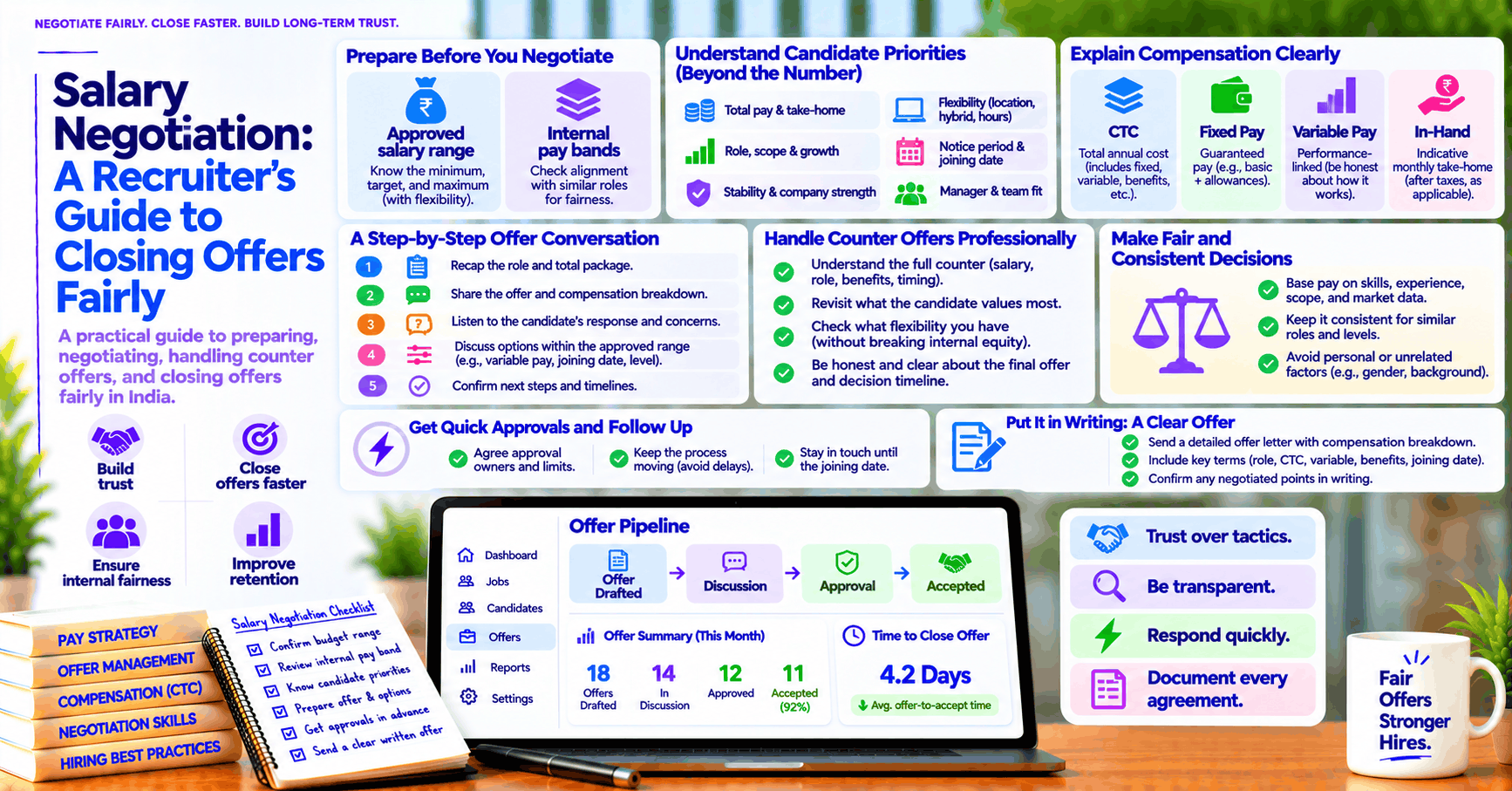
Good salary negotiation for recruiters comes down to preparation, transparency, and speed. Know your approved budget range before the first call, understand what the candidate actually wants beyond the number, explain the full compensation structure clearly, and respond to counter offers quickly and honestly. Tracking expectations, budget bands, and offer stages in one place, such as the RecruitKar ATS pipeline, keeps every conversation consistent and documented. This guide covers how to prepare, how to run the negotiation conversation, how to handle counter offers, and how to close fairly.
Why Negotiation Is Really About Trust
Many recruiters treat negotiation as a contest: get the candidate for the lowest number, or hold the line until they give in. That approach often wins the offer and loses the hire. A candidate who feels squeezed may accept and then leave within months, or may accept a competing offer at the last minute.
A better frame is that negotiation is a shared problem: the company has a budget and an internal pay structure, the candidate has needs and alternatives, and your job is to find an arrangement that works for both within real limits. When candidates feel they were treated honestly, they are more likely to accept, join, and stay. When existing employees later discover that a new hire was paid unfairly more or less than peers, it affects morale too.
Fair does not mean everyone gets the same number. It means decisions follow consistent, job-related reasons such as skills, experience, scope, and market data, and not personal factors like gender, background, or how well someone negotiates.
Before You Negotiate: Preparation That Saves Time
Most negotiation problems start before the conversation. Do the following groundwork first.
Get the budget in writing. Confirm the approved salary range and any flexibility for the role with the hiring manager and your finance or HR partner. Know the minimum, the target, and the maximum. Also confirm what can move, such as joining bonus, variable pay, or level, and what cannot.
Understand the internal pay structure. Check how the role compares with others at the same level in your company. An offer that breaks internal fairness creates a bigger problem later than a lost candidate.
Know the market. Use sources you trust, such as your own recent offers, salary discussions with candidates, and reputable compensation surveys. Avoid quoting statistics unless you can name the source and confirm they are current.
Learn the candidate's priorities early. Ask about expectations during the first screening call, not at the offer stage. Then keep notes. Recording expected pay, notice period, other offers, and reasons for leaving in the candidate's record means the information is available to everyone who talks to them.
Agree the process with the hiring manager. Decide who can approve exceptions, how fast approvals will come, and who speaks to the candidate. A delay while you chase approvals is one of the most common reasons offers fall through.
Understanding the Candidate's Real Priorities
The number is rarely the only factor. Before negotiating, find out what the candidate cares about. Typical drivers include:
- Fixed pay. Total fixed compensation, and how much of it is take-home.
- Variable pay and bonuses. How predictable and how achievable they are.
- Role and growth. Title, scope, learning, and career path.
- Stability. Company strength and job security, particularly for candidates burned by layoffs.
- Flexibility. Work location, hybrid or remote options, hours, and leave.
- Notice period and joining date. Some candidates need a buyout, a later start date, or a break between jobs.
- Manager and team. Many candidates accept lower pay for a manager they trust.
- Reasons for leaving. If someone is leaving because of a bad manager, a higher number alone will not fix that.
A useful question is: "Besides compensation, what would make this a clear yes for you?" The answer often shows where you have room to move without increasing the base salary.
Talking About Pay in India: CTC, Fixed, Variable, and In-Hand
Compensation structures in India often confuse candidates, and confusion causes distrust. Spend time explaining the structure clearly.
Cost to company (CTC). This is the total annual cost of employing the person. It may include fixed pay, variable pay, employer contributions to benefits, and other components. Many candidates focus on the headline CTC without knowing what is included.
Fixed versus variable. Explain which parts are guaranteed and which depend on performance or company results. Be honest about how variable pay has paid out historically, without promising future results.
In-hand pay. Candidates care about monthly take-home. Where possible, share an indicative breakdown, and note that actual figures depend on tax choices and individual circumstances. Encourage candidates to confirm details with their own tax advisor.
Benefits and allowances. Insurance, retirement contributions, reimbursements, and other benefits have real value. List them clearly, but avoid putting a rupee value on anything you cannot verify.
Put the structure in writing. A simple one-page compensation breakdown sent with the offer reduces back-and-forth and misunderstandings. Have HR or finance confirm all numbers before they go out.
Step-by-Step: Running the Negotiation Conversation
Step 1: Raise compensation early
Do not leave pay for the end. Ask about expectations in the first conversation, and share the budget range for the role when you can. Early alignment saves everyone time. If the candidate's expectation is far outside your range, it is kinder to say so early than after four interview rounds.
Step 2: Ask, listen, and note
When the candidate shares an expectation, do not react with surprise or approval. Ask what it is based on, and what other options they are considering. Record the answers.
Step 3: Make the offer by call, not only by email
Offers made only by a written email can feel cold, and they remove your chance to read the candidate's reaction. A call lets you present the offer, explain the reasoning, and hear concerns immediately. Follow up in writing so that terms are documented. You can use RecruitKar's voice calls to reach candidates quickly and keep the conversation moving, and send the written offer through email outreach.
Step 4: Explain the reasoning
Say how you arrived at the offer: the level, the scope, the internal band, and what the candidate brings. A number with a reason is easier to accept than a number alone.
Step 5: Listen to the response before answering
If the candidate asks for more, find out why. Is it a specific figure they need, a gap against another offer, or a concern about growth? You can only solve the problem you understand.
Step 6: Offer options, not just a yes or no
If the base salary has a ceiling, look at other levers: joining bonus, a review at six months with clear criteria, a different mix of fixed and variable pay, a start-date adjustment, or additional leave. Only promise what you are authorised to deliver, and document it.
Step 7: Get approvals quickly
Tell the candidate when you will come back to them, and keep to it. For example: "I will speak to the hiring manager today and call you back by tomorrow afternoon." A fast, honest response builds more confidence than a slightly higher number delivered late.
Step 8: Confirm in writing
Once you agree on terms, send a clear offer letter or summary. Ask the candidate to confirm they understand and accept. Track the offer status in your pipeline so hiring managers can see where things stand.
How to Handle a Counter Offer From the Current Employer
Counter offers are one of the biggest causes of offer drop-off. A candidate who resigns often hears a better package, a promotion, or an emotional appeal from their current employer.
Prepare for it before it happens. During interviews and the offer call, ask: "If your current company counters, how would you think about it?" Candidates who have already thought it through are less likely to be swayed on impulse.
Revisit why they wanted to leave. If the main reasons were growth, manager, or work content, a salary increase does not usually change them. Gently remind the candidate of the reasons they shared with you.
Do not badmouth the current employer. Stay professional. Focus on what your company offers, not on what is wrong with theirs.
Do not get into a bidding war. Raising your offer repeatedly in response to counters rarely ends well. Decide in advance what your maximum is and what you can fairly justify against your internal structure.
Stay in touch during the notice period. Candidates serving a notice period are exposed to counters, second thoughts, and other offers. Regular, friendly contact helps. A simple check-in call or message through WhatsApp, a welcome note from the hiring manager, or an invitation to meet the team keeps the candidate engaged.
Accept that some candidates will stay. If someone chooses to remain, respond graciously and keep the door open. Many return later.
Common Negotiation Situations and How to Handle Them
The candidate expects much more than your range. Be direct about the budget and what the role can offer. Ask if there is flexibility on their side, and explore non-salary factors. If the gap remains, part on good terms rather than stretching beyond what you can justify.
The candidate will not share their current pay. Many candidates prefer not to disclose it, and that is a reasonable position. Ask about expectations instead, and anchor on the role's range and the candidate's skills. Avoid pressuring anyone to reveal personal salary information.
The candidate has multiple offers. Ask what matters most to them, and be honest about where you can compete and where you cannot. Move quickly. Speed is often the deciding factor between two similar offers.
The candidate accepts and then goes quiet. Reach out before the joining date. Confirm documents, joining formalities, and any concerns. Silence after acceptance is a warning sign.
The hiring manager wants to go below the budget. Explain the risk to the manager: a very low offer may be rejected, or accepted by someone who leaves soon. Share what you have learned from the candidate's priorities and the market.
The hiring manager wants to go well above the band. Explain the internal fairness issue. Suggest alternatives such as a higher level, a review milestone, or a one-time component, if the company policy allows.
Negotiating Fairly: Practices That Protect Everyone
- Use job-related reasons for pay. Base offers on skills, experience, scope, and market data. Do not base them on gender, background, or how the candidate negotiates.
- Apply a consistent range. Keep documented bands for each role and level, and review exceptions with HR.
- Be honest. Do not invent competing offers, claim your budget is lower than it is, or make promises you cannot keep.
- Do not pressure with fake deadlines. Give candidates a reasonable time to decide, typically a few days, and explain any real constraints such as hiring timelines.
- Document everything. Record what was said and agreed in the candidate's record. Clear notes protect both sides if there is a later dispute.
- Review for pay equity. Periodically compare offers for similar roles to catch unexplained gaps.
Speed and Follow-Up: Where Many Offers Are Won or Lost
In many cases, the company that responds fastest and communicates best wins the candidate, even when the offers are close. Build speed into your process.
- Pre-approve ranges so you can make offers without waiting for sign-off each time.
- Schedule the offer call as soon as the final interview feedback is in. If you are using interview scheduling in RecruitKar, you can keep final rounds and next steps tightly connected.
- Follow up within a day on any candidate question or counter.
- Keep candidates informed about timelines. Silence feels like disinterest.
- Track every offer stage in a shared pipeline so nothing waits for someone to remember it.
If you want a single place where expectations, offer stages, outreach, and interview scheduling are tracked together, see how RecruitKar works for recruiting teams. Smaller teams without a dedicated HR function can also look at RecruitKar's startup solution.
A Simple Offer Call Outline
You can adapt this structure for the offer call:
- Open warmly. Thank the candidate for their time and say you have good news.
- Share the offer. State the role, level, compensation structure, and joining timeline.
- Explain the reasoning. Briefly describe how you arrived at the numbers.
- Pause and listen. Ask how they feel about the offer.
- Explore concerns. Ask what would make it a clear yes.
- Agree next steps. Confirm when you will send the written offer, when you expect a response, and who they can contact with questions.
- Follow up in writing the same day.
A Note on Compensation, Contracts, and Compliance
This article is for general information and is not legal advice. Offers involve employment terms, compensation structures, notice periods, data about candidates' pay and other offers, and, in some cases, equal pay and anti-discrimination obligations. Have your legal counsel or HR compliance advisor review your offer templates, your approach to asking about salary history, and how you store negotiation notes. Tax treatment of individual pay components varies, so candidates should confirm specifics with their own advisor.
Frequently Asked Questions
1. How do I negotiate salary with a candidate without losing them?
Be transparent about your budget range early, learn what the candidate values beyond the number, and explain how you arrived at your offer. If you cannot raise the base pay, explore other levers such as joining bonus, a defined review point, variable pay, or start date. Respond quickly to every counter, and keep your promises realistic. Candidates stay engaged when they feel respected and informed.
2. Should I ask a candidate for their current salary?
Many recruiters ask, but a growing number of companies prefer to focus on expectations and the value of the role instead. Candidates are often uncomfortable sharing current pay, and basing offers on past salary can carry forward earlier pay gaps. Asking about expectations and sharing the role's range gives you the information you need without pressure. Check your company's policy and legal advice on this topic.
3. How do I handle a counter offer from the candidate's current employer?
Talk about it before it happens. Ask the candidate how they would respond to a counter, and remind them of the reasons they wanted to leave. Do not enter a bidding war, and stay in touch during the notice period. Accept that some candidates will stay, and leave the relationship in good standing.
4. What can I offer if the budget is fixed?
If base pay cannot move, look at what the company can authorise: joining bonus, a performance review at a set point, a different fixed-to-variable mix, a higher title or level where appropriate, flexible work arrangements, additional leave, or a start-date adjustment. Only offer what you are authorised to deliver, and put it in writing.
5. How long should I give a candidate to accept an offer?
A few working days is a common and reasonable window, though it depends on role seniority and your hiring timeline. Give candidates enough time to consider and talk to family or other employers, and be open about any real deadlines. Artificial pressure tends to backfire. Keep in touch during the decision period so you can answer questions promptly.
Final Thoughts
Closing an offer fairly is less about clever tactics and more about preparation, honesty, and speed. Know your range, learn the candidate's real priorities, explain compensation clearly, respond quickly, and document what you agree. Candidates who feel respected are more likely to join, stay, and recommend your company to others.
If you want your pipeline, outreach, and interview scheduling in one place so that no offer waits on someone's memory, explore RecruitKar and see how it fits your hiring workflow.