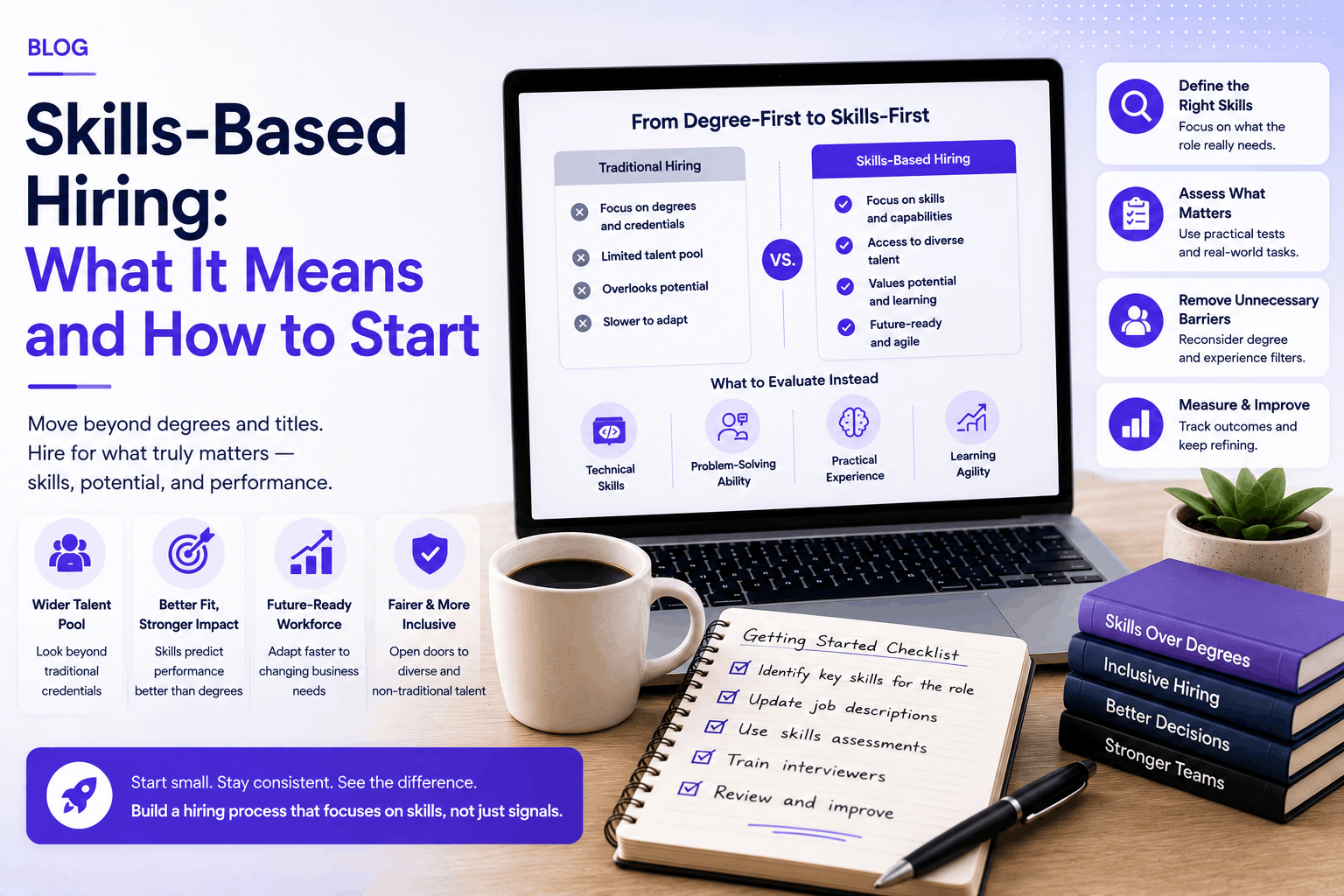
For decades, a college degree functioned as a rough proxy for competence in hiring — not because employers necessarily believed the degree itself taught the exact skills needed, but because it was a convenient, standardized filter for a large applicant pool. That convenience came with a real cost: capable candidates who took a different path — self-taught skills, vocational training, career changes, non-traditional education — were routinely filtered out before anyone even looked at what they could actually do.
Skills-based hiring is the shift away from that proxy, toward evaluating candidates more directly on the actual skills a role requires. It's not a new idea, but it's gained real momentum recently, driven by a mix of talent shortages in specific skill areas, growing evidence that degree requirements often screen out qualified candidates unnecessarily, and better tools for actually assessing skills at scale. This post covers what skills-based hiring actually means in practice, why it's gaining traction in India specifically, and concrete steps to start shifting toward it without a wholesale process overhaul.
What skills-based hiring actually means
At its core, skills-based hiring means defining a role by the specific competencies required to do it well, and evaluating candidates against those competencies directly — rather than using a degree, a specific job title history, or years-of-experience as a stand-in for competence.
This doesn't mean credentials or experience become irrelevant. It means shifting the starting question from "does this candidate have the expected credentials?" to "can this candidate actually do what the role requires?" — and building a hiring process that can genuinely answer that second question.
A few concrete examples of what this looks like in practice:
- A software role that previously required a computer science degree instead evaluates candidates through a coding assessment or portfolio review, opening the door to self-taught developers and bootcamp graduates alongside traditionally trained ones.
- A marketing role that previously specified "3+ years in a marketing role" instead asks candidates to complete a short case study demonstrating relevant analytical and creative skills, regardless of whether their prior job title said "marketing."
- A customer support role drops a blanket degree requirement entirely, since the actual skills needed — communication, problem-solving, patience under pressure — aren't meaningfully predicted by having a degree in any particular field.
Why this is gaining traction now, especially in India
Talent shortages in specific skill areas. In fast-growing fields — certain technology roles, specialized manufacturing skills, data-related roles — the pool of candidates with the "traditional" credential simply isn't large enough to meet demand, pushing companies to look more broadly at how else competence can be demonstrated.
Evidence that degree requirements often don't predict job performance well. A growing body of research and internal company data has found that degree requirements, especially for roles where the actual work doesn't directly draw on academic training, correlate weakly with on-the-job performance — while excluding a meaningful pool of otherwise qualified candidates.
A large, increasingly credentialed-but-non-traditional talent pool in India specifically. India has a large population of candidates with relevant skills gained through non-degree routes — vocational training, certification programs, bootcamps, self-directed learning, and on-the-job experience in adjacent roles — that a strict degree-first filter overlooks entirely.
Better tools for actually assessing skills at scale. Skills-based hiring was historically harder to implement at volume because assessing actual competence, rather than checking a credential box, took more effort per candidate. Structured assessments, work-sample tests, and AI-assisted matching that scores against actual described skills and experience — rather than job titles or degrees — have made this more practical to do consistently, even at higher hiring volumes.
Where skills-based hiring genuinely helps
Widens the qualified candidate pool. Removing an unnecessary degree requirement or overly narrow job-title expectation opens up candidates who would previously have self-selected out or been filtered before a human ever reviewed their application.
Reduces reliance on proxies that don't actually predict performance well. Years-of-experience and degree credentials are convenient shortcuts, but they're imperfect ones — someone with three years of intensive, hands-on experience can easily be more capable than someone with seven years of relatively passive experience in a similar title.
Can reduce certain forms of bias, if implemented carefully. Since degree and pedigree requirements have historically correlated with socioeconomic background in ways unrelated to actual job competence, shifting evaluation toward demonstrated skill can reduce (though not eliminate) some of that structural bias — though this depends heavily on how the skills assessment itself is designed.
Often improves retention and internal mobility. Companies that have shifted toward skills-based hiring frequently report being better able to identify internal candidates for new roles too, since the same skills-first framework applies to evaluating existing employees for growth opportunities, not just external hires.
Where it's genuinely harder, and worth being honest about
Building good assessments takes real effort. A poorly designed skills assessment can be just as biased or unreliable as a degree requirement — if it's not carefully validated against what the role actually requires, it just becomes a different, potentially equally flawed filter.
Some roles genuinely do require specific credentials. Regulated professions — certain healthcare, legal, financial, and engineering roles — have real credentialing requirements that exist for legitimate reasons (safety, legal compliance, liability), and skills-based hiring isn't a wholesale replacement for that in every context.
It requires more upfront work per requisition than reusing a standard job description template. Defining the actual skills a role requires, and designing a way to assess them, takes real thought — it's a meaningfully bigger lift than copying last year's JD and adjusting the years-of-experience number.
Hiring managers may need convincing. A hiring manager used to filtering by degree or specific prior job titles may be skeptical of a process that asks them to evaluate candidates differently — this is often more of a change-management challenge than a technical one.
How to actually start, without a full process overhaul
1. Start with one or two roles, not a company-wide policy change
Trying to convert an entire hiring process to skills-based evaluation all at once is a lot to manage well. Pick a role or two — ideally ones where you suspect degree or title requirements might be unnecessarily narrowing your pool, or where you're already struggling to fill openings through traditional channels — and pilot a skills-first approach there first.
2. Define the actual skills required, specifically
This is the foundational step, and it's worth doing properly rather than rushing. For the pilot role, work with the hiring manager to identify what someone genuinely needs to be able to do to succeed — not a generic list, but specific, assessable competencies. This connects directly to writing a better job description in general: a JD that clearly separates genuine requirements from nice-to-haves, and describes outcomes rather than just listing tasks, is already halfway to being skills-based.
3. Build or adopt an assessment that actually measures those skills
This could be a work-sample test, a structured case study, a portfolio review, or a practical exercise relevant to the role — the format matters less than whether it genuinely measures the skills you defined, rather than defaulting back to credentials or a generic interview that mostly assesses interview performance rather than job performance.
4. Adjust sourcing to reach a broader pool
If your sourcing has historically filtered by degree or specific job titles, this needs to change alongside the evaluation criteria, or you'll still be missing the candidates skills-based hiring is meant to reach. Context-aware matching — evaluating a candidate's actual described experience and skills rather than searching for specific keywords or credentials — is better suited to this than a rigid, credential-based search.Recruitkar's AI candidate discovery, for instance, matches against the substance of a job description rather than requiring exact keyword or credential matches, which is directly relevant to sourcing for a skills-first role rather than a traditionally-credentialed one.
5. Track outcomes, and be willing to adjust
Compare how candidates hired through the skills-based process actually perform against your historical hiring for similar roles. This isn't just a sanity check — it's also the evidence you'll need to make the case for expanding the approach to more roles, particularly if hiring managers were initially skeptical.
6. Expand gradually, informed by what actually worked
Once you have real results from a pilot, expand to additional roles where a similar shift makes sense — rather than assuming the same approach transfers unchanged to every role. Some roles will benefit enormously from a skills-first approach; others, particularly those with genuine credentialing requirements, won't be good candidates for the shift at all.
Common objections, and honest responses to them
"If we drop the degree requirement, won't we just get flooded with unqualified applicants?" This is a fair concern, and it's exactly why the assessment step matters as much as it does — removing a credential filter without replacing it with a real skills assessment does risk a less qualified pool. The fix isn't to keep the degree requirement as a lazy proxy; it's to invest properly in an assessment that actually screens for competence directly, which if done well should produce a more accurately qualified pool, not a less qualified one.
"Our hiring managers trust degrees and specific backgrounds — how do we get buy-in?" Piloting on a small number of roles, then sharing real performance data comparing skills-hired candidates against traditionally-hired ones, tends to be far more persuasive than an abstract policy argument. Hiring managers are usually pragmatic about what actually works once they see evidence, even if they were initially skeptical of the approach in principle.
"Doesn't this just shift bias from credentials to whatever the assessment measures?" This is a legitimate risk, not a hypothetical one — a poorly designed assessment absolutely can encode its own biases, just as a degree requirement did. This is exactly why assessments need to be genuinely validated against what the role requires, ideally reviewed by more than one person, and periodically audited for whether they're producing meaningfully different outcomes across different candidate backgrounds in ways that don't map to actual job performance.
"Isn't this just a lot more work than screening by degree and years of experience?" Per requisition, yes, it's more upfront effort — but that effort tends to pay off in a meaningfully wider and often better-matched candidate pool, particularly for roles where you're currently struggling to fill openings through traditional credential-based sourcing. It's also worth noting that once an assessment is built for a given role, it can typically be reused for future openings of the same type, which reduces the marginal effort over time.
A quick note on internal mobility
Skills-based hiring isn't only about external hiring — the same principle applies to how you evaluate existing employees for new roles or promotions. An employee who's built relevant skills in an adjacent role, but doesn't have the "expected" title history for a new opportunity, is exactly the kind of internal candidate a skills-first framework is designed to surface rather than overlook. Companies that apply this thinking consistently — both externally and internally — tend to build a more accurate, more current picture of what capability actually looks like across their workforce, rather than relying on titles and tenure as a proxy.
What a skills-first job description looks like in practice
The shift toward skills-based hiring shows up most concretely in how a job posting itself is written. Instead of "Bachelor's degree in Computer Science required, 4+ years experience," a skills-first version might read: "You should be comfortable building and debugging production-level applications independently, and able to demonstrate this through a portfolio, prior work samples, or a practical assessment — a specific degree or number of years isn't required if you can show this." The difference isn't just softer language — it changes who feels qualified to apply, and it sets up the actual screening process to evaluate the thing that matters (demonstrated capability) rather than a proxy for it. Teams making this shift often find it useful to explicitly state in the posting itself that non-traditional backgrounds are welcome, since candidates who've internalized years of degree-first hiring norms may otherwise self-select out even when a role has genuinely moved to skills-based criteria.
The bottom line
Skills-based hiring is ultimately a shift in what question you're asking a candidate to answer — not "what credential do you have" but "can you actually do this." It takes more upfront effort to define and assess properly than reusing a standard job description template, and it isn't the right fit for every role, particularly those with genuine credentialing requirements. But for the many roles where a degree or specific title history was always a rough proxy rather than a real requirement, shifting toward direct skills evaluation tends to widen a qualified candidate pool that traditional filters were quietly excluding — which, done carefully, is a genuine improvement in hiring quality, not just a trend to follow.