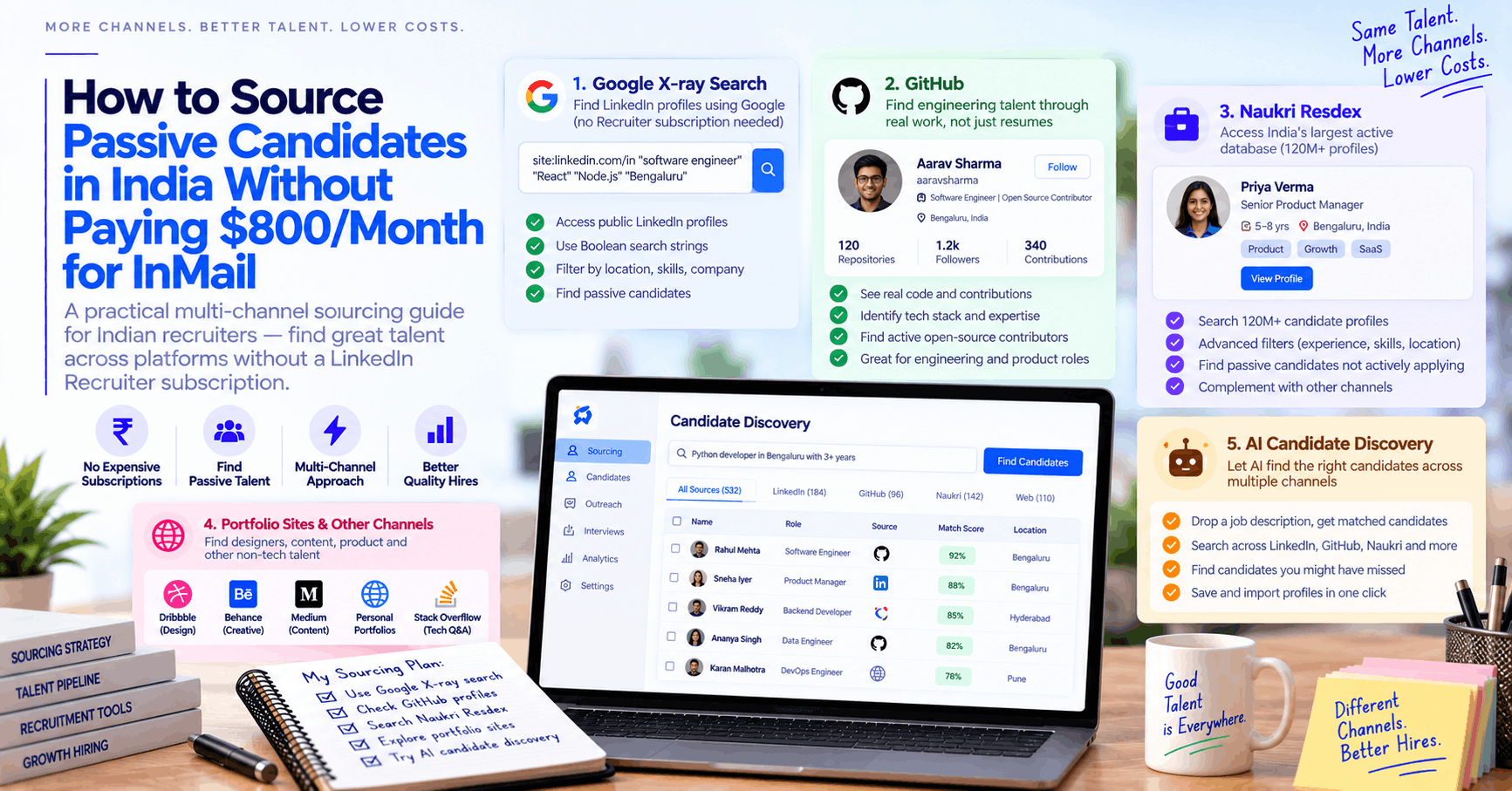
LinkedIn Recruiter costs 800–1,200/month per seat in USD — and it still only reaches the candidates who are active on LinkedIn, still depends on InMail response rates that have been declining for years, and still relies on keyword search that misses qualified candidates who describe their experience differently than your search string expects. For Indian recruiters, there's a better answer: a multi-channel sourcing approach that combines GitHub, Google X-ray search, Naukri Resdex, public portfolio sites, and RecruitKar's AI candidate discovery — reaching passive candidates across every channel they're actually active on, at a fraction of the InMail cost.
This guide breaks down each channel, what it's genuinely good for, and how to combine them into a sourcing workflow that doesn't depend on a single expensive subscription.
Why passive candidates are worth the extra effort
Passive candidates — professionals who aren't actively applying to jobs but who would consider the right opportunity — represent a disproportionate share of the best hiring outcomes. They're typically employed, usually performing well in their current role (otherwise they'd be looking), and often have the specific experience that's hard to find in active job-seeker pools.
The challenge is that they don't come to you. They're not on Naukri uploading a freshly updated resume. They're not sending connection requests on LinkedIn. Finding them requires going where they are — which is different from where active candidates are, and different depending on the role type.
For tech roles, passive candidates often signal their interests and abilities through GitHub contributions, Stack Overflow answers, technical blog posts, open-source project involvement, and conference talks — all of which are publicly searchable without any subscription. For non-tech roles, the signals are different but still findable: LinkedIn public profiles, portfolio sites, Behance for designers, Medium for content and strategy professionals.
Channel 1: Google X-ray search on LinkedIn public profiles
LinkedIn's public profiles are indexed by Google — which means you can search them without a LinkedIn Recruiter subscription using Google's site: operator. This is one of the most widely used but underexplained sourcing techniques in India.
Basic syntax:
site:linkedin.com/in "software engineer" "React" "Node.js" "Bengaluru"
This returns LinkedIn profiles of people who list Software Engineer, React, and Node.js on their public profile and whose location or experience mentions Bengaluru — without requiring a single InMail credit.
More targeted:
site:linkedin.com/in ("senior software engineer" OR "lead engineer") "fintech" ("Bengaluru" OR "Hyderabad") -"looking for opportunities"
The -"looking for opportunities" exclusion filters out profiles where the person has added a banner signal that they're actively searching — leaving profiles more likely to belong to passive candidates.
For engineering leadership:
site:linkedin.com/in ("engineering manager" OR "VP engineering" OR "director of engineering") "SaaS" "Series B" OR "Series C" "India"
Practical limitations: Google X-ray only returns profiles whose privacy settings allow public indexing — candidates who have set their profile to private won't appear. And you can view the profile in Google's cache but can't contact them without a LinkedIn connection or InMail. The import profiles from LinkedIn Chrome extension lets you save and import shortlisted profiles directly into your pipeline as you browse.
Generating X-ray strings quickly: Rather than building every string from scratch, RecruitKar's Google X-Ray search strings tool generates role-specific, location-specific Boolean strings formatted for Google X-ray — paste into Google and you have a searchable candidate pool in under 2 minutes.
Channel 2: GitHub for engineering and open-source contributors
GitHub is the single most underused sourcing channel for engineering talent in India. A developer's public GitHub profile shows:
- Languages and frameworks they actually use (not just list on a resume)
- Contribution recency and activity
- Code quality through public repository history
- Open-source involvement in well-regarded projects
- Documentation habits and communication through commit messages and PR descriptions
How to search GitHub for candidates:
GitHub's search function (github.com/search) allows filtering by location, language, and repository topic:
location:India language:Python followers:>50
This returns developers in India whose primary language is Python and who have more than 50 followers — a proxy for some level of recognition in the community.
location:Bengaluru language:Go stars:>10
Developers in Bengaluru whose Go repositories have received 10+ stars from others.
GitHub Awesome lists: Many technology areas have community-maintained "Awesome [Technology]" repositories listing contributors to that ecosystem. Searching for active contributors to these lists surfaces practitioners who are clearly engaged in the field, often at a depth that resume screening doesn't surface.
Direct outreach: GitHub profiles typically include an email address in the public profile or a website link — both of which can be used for direct outreach. A message that references specific repository work ("I noticed your contributions to [project] — we're solving a similar problem at [Company]") consistently outperforms generic cold outreach precisely because it demonstrates you've actually looked at their work.
Channel 3: Naukri Resdex — the largest passive-includant database in India
Naukri Resdex isn't only for active job seekers. The database includes profiles of candidates who haven't actively applied to anything recently but whose profiles remain searchable — in Indian recruiting, this is as close to a passive candidate database as exists at scale.
The key to using it for passive sourcing rather than active-applicant matching:
Filter for candidates who haven't applied recently. Most Resdex search interfaces allow filtering by "last active" date. Candidates who haven't updated their profile or applied in the past 6–12 months are more likely to be passively contactable than ones who've been active this week.
Use notice period filters strategically. A candidate with a listed notice period of 60–90 days who hasn't been active recently is likely currently employed and not urgently looking — passive, and reachable.
Focus on resume keywords over job application history. Resdex's full-text resume search reaches the content of uploaded resumes, not just the search-optimised summary — which means you can find candidates whose specific project descriptions mention the technology or domain you're sourcing for, even if their profile title doesn't match your search term.
Boolean search strings formatted for Naukri — covering the title:, skill:, np:, and loc: operators — produce meaningfully better results than plain keyword searches in Resdex. If this is new territory, the separate guide on Naukri Boolean search for tech roles covers the field operators in detail.
Channel 4: Portfolio and personal sites
For designers, content strategists, front-end engineers, and UX researchers, personal portfolio sites are the most direct signal of actual work quality available — better than a resume and often more up to date than a LinkedIn profile.
Finding them:
Google search with portfolio-specific terms:
site:behance.net "product designer" "India" 2024 OR 2025
"portfolio" OR "case study" "UX designer" "fintech" "India" filetype:html
Dribbble profiles for visual designers; Medium or Substack for content and strategy professionals; personal GitHub Pages sites for front-end engineers.
What to look for once you find them:
The quality and recency of the work. Whether they write about their process, not just their outputs. Whether the projects they feature align with the type of work your role involves. Contact information — most portfolio sites include a contact page or linked email.
Outreach: A message that references specific portfolio work ("I looked at your case study on the checkout redesign — the usability testing approach you used is directly relevant to a problem we're working on") produces response rates far above generic outreach, because the candidate sees immediately that you've invested actual attention rather than mass-blasting.
Channel 5: AI-powered candidate discovery
The channels above are high-value but individually labour-intensive. AI candidate discovery automates the matching layer — taking a job description as input and returning a ranked list of candidates from across multiple sources (professional databases, previous applicants, job board profiles) matched by actual experience and skills rather than keyword overlap.
RecruitKar's AI candidate discovery works by comparing the semantic content of a JD against the semantic content of candidate profiles — identifying candidates whose described experience is genuinely relevant to the role, even if they use different terminology or have a non-standard title. A candidate who spent 4 years as a "Growth Lead" doing paid acquisition work surfaces as a match for a "Performance Marketing Manager" search, because the underlying experience is semantically similar even if the keywords don't align.
Where it fits in the multi-channel workflow:
AI discovery handles the volume layer — surfacing a ranked list from a large pool quickly. The manual channels (GitHub, X-ray, portfolio sites) handle the depth layer — finding specific candidates with evidence of exceptional work that a database search wouldn't surface. The highest-quality sourcing combines both: AI discovery for coverage, manual sourcing for the high-signal candidates you specifically want to pursue.
Channel 6: Technical communities and forums
Developers, data scientists, and other technical professionals congregate in communities that are publicly searchable even when the members aren't thinking about job opportunities:
Stack Overflow: Search for highly-upvoted answers in specific technology tags from India-based accounts. A developer with 5,000+ reputation points in a specific technology area, with an India location flag, is a demonstrably active practitioner.
Discord and Slack communities: Many Indian tech communities (HasGeek, BangPypers, PythonIndia, specific framework communities) have public member directories or public channels where active contributors are identifiable.
Conference speaker lists: Speakers at JSFoo, Rootconf, PyConf India, and similar conferences are publicly listed. Someone who proposed and delivered a technical talk on a specific topic is demonstrably expert in it — and is findable through the conference archives, often with a LinkedIn or Twitter profile linked.
Reddit (r/india, r/cscareerquestions, r/cscareerquestionsIN): The India-specific subreddits include professionals who discuss their career situations publicly — occasionally people who are passively open to opportunities mention it in threads, and profiles that post frequently on technical topics are identifiable practitioners.
Combining the channels: a practical sourcing workflow
For a senior data engineer role in Bengaluru:
Channel
Time investment
Candidate yield
Signal quality
AI candidate discovery
15 min setup
30–60 matched profiles
Medium-high
Naukri Resdex Boolean
30 min
50–200 profiles
Medium
GitHub search
45 min
10–25 profiles
High
Google X-ray (LinkedIn)
20 min
20–50 profiles
Medium
Stack Overflow
30 min
5–15 profiles
Very high
Conference speakers
20 min
3–8 profiles
Very high
Total time investment: ~2.5 hours. Total candidate pool from all channels: 120–360 profiles, de-duplicated and combined. The highest-signal candidates (GitHub contributors, Stack Overflow experts, conference speakers) go to the top of personal outreach priority. The broader Resdex and AI-discovery pool gets a sequenced email + WhatsApp outreach cadence.
The entire pool flows into the pipeline through RecruitKar's sourcing channels — Naukri and LinkedIn imports via Chrome extension, AI discovery candidates directly, manually found candidates via quick profile add — so all outreach history, screening, and interview scheduling is tracked in one place regardless of which channel produced each candidate.
Outreach that actually gets replies from passive candidates
The outreach message is where most sourcing effort fails. A passive candidate who receives a generic InMail about an "exciting opportunity" — the same message they've received seventeen times this month — doesn't reply. A message that demonstrates specific knowledge of their work gets read differently.
The formula that works:
- One sentence referencing something specific they've done (a GitHub repo, a conference talk, a specific project listed on their LinkedIn, a blog post)
- One sentence on the specific problem your company is working on that is directly relevant to that experience
- One clear, low-commitment ask — usually a 15-minute call, not a formal interview
The message should be short enough to read on a phone screen without scrolling. For Indian candidates, WhatsApp often gets a faster response than email or LinkedIn for the follow-up — leading with email and following with WhatsApp 3–4 days later is the sequence that produces the highest combined response rate.
Frequently asked questions
Is scraping LinkedIn profiles for sourcing legal in India? Google X-ray search accesses publicly indexed LinkedIn profiles — this is not scraping in the technical or legal sense; it's using a search engine to find publicly available information. Bulk automated scraping of LinkedIn data using bots or automated tools violates LinkedIn's Terms of Service regardless of jurisdiction. The manual workflow described above — using Google to find profiles and then browsing them individually — is within normal acceptable use. When in doubt, consult your legal team on the specific use case.
How do I contact a candidate I found on GitHub or a portfolio site if they haven't listed an email? GitHub profiles often link to a personal website or Twitter/X profile, which typically includes a contact method. Portfolio sites generally have a contact page. In the absence of direct contact information, a LinkedIn search for the same person's name and location (after finding them on GitHub) often surfaces a LinkedIn profile you can connect on. As a last resort, a GitHub issue or pull request comment is an unconventional but sometimes effective way to make initial contact with active open-source contributors.
What response rate should I expect from passive candidate outreach? Genuinely personalised outreach to highly relevant passive candidates — where the first sentence references specific work they've done — typically sees 20–35% response rates on the first touch. Generic outreach to a passive candidate list typically sees 3–8%. The difference is almost entirely in the personalisation, which takes an extra 5 minutes per candidate but produces 3–5x the response rate.
How many passive candidates should I source before starting active outreach? Build the full list before starting outreach on any of them. Starting outreach on the first 10 candidates while still sourcing the remaining 40 means your outreach cadence is inconsistent and your pipeline fills unevenly. Source a complete batch (typically 50–100 for a mid-level role), prioritise by signal quality, then launch the outreach sequence simultaneously across the full list.
Does this approach work for non-tech roles? Yes, with different channels. For sales, finance, operations, and marketing roles, the GitHub and Stack Overflow channels don't apply, but LinkedIn X-ray, Naukri Resdex, personal websites (LinkedIn article authors, Substack writers), and industry community groups (LinkedIn groups, WhatsApp professional groups in specific industries) produce comparable candidate pools. The outreach principles are identical regardless of role type.
Explore 7 ways to source candidates on RecruitKar — from AI discovery that matches by experience rather than keywords, to 1-click imports from Naukri and LinkedIn, to direct profile add from any source. AI candidate discovery — start sourcing in minutes.