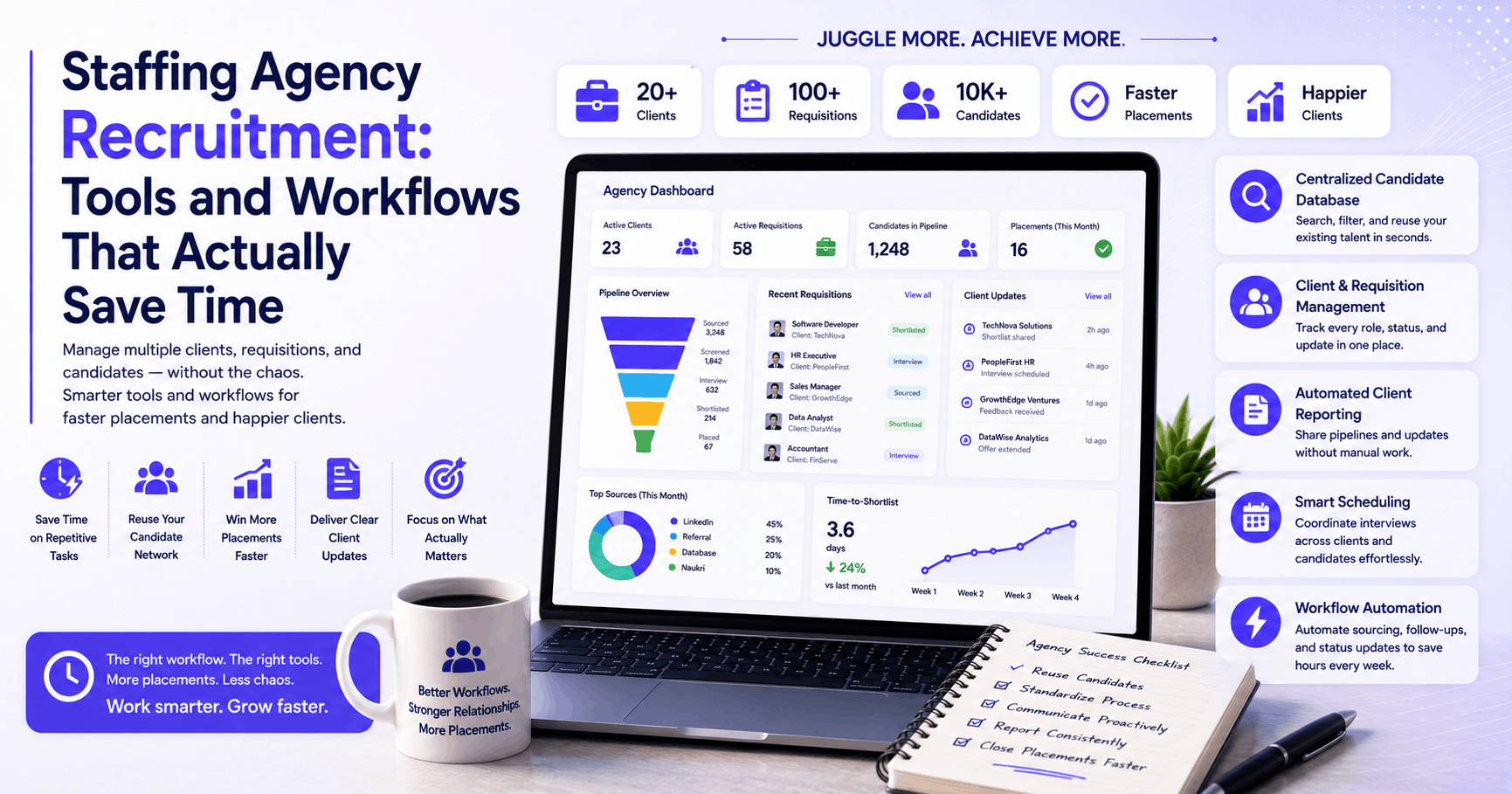
In-house recruiters juggle multiple open roles. Staffing agency recruiters juggle multiple open roles, across multiple clients, each with different requirements, different urgency levels, different points of contact, and often, different expectations about how often they want to be updated. That extra layer — managing the client relationship on top of managing the hiring process itself — is what makes agency recruiting a genuinely different discipline, and why tools and workflows built for in-house teams don't always translate cleanly to agency work.
This post covers what's specifically different about agency recruiting, and practical workflows and tooling choices that actually reduce the chaos rather than adding another system to manage on top of everything else.
What's structurally different about agency recruiting
You're serving two customers at once. The candidate is one relationship to manage; the client is another, with their own expectations about communication frequency, shortlist quality, and turnaround time. A workflow that only optimizes for candidate experience, or only for client reporting, misses half the job.
Requisitions are more varied and less predictable. An in-house recruiter often works within one company's hiring patterns and culture. An agency recruiter might move from a technical role for one client to a completely different industry and seniority level for the next, sometimes within the same week — which makes standardized rubrics harder to build and reuse compared to in-house hiring.
Candidate pipeline reuse matters enormously. A strong candidate who wasn't right for Client A's role might be a great fit for Client B's role next month. Agencies that can't easily search and resurface their own historical candidate pool end up re-sourcing people they already had contact with, which is pure wasted effort.
Client reporting is a core deliverable, not an afterthought. Clients often want visibility into pipeline status, time-to-shortlist, and source quality — this isn't optional reporting for internal use, it's part of what a client is paying for, and a workflow that can't produce this easily becomes a manual reporting burden every week.
Speed is often a direct competitive differentiator. Clients frequently work with multiple agencies simultaneously for the same role, whether or not that's explicit — the agency that produces a strong shortlist fastest often wins the placement, which makes process speed matter even more than it does in-house.
Where time actually gets lost in agency workflows
Re-sourcing candidates the agency has already found before. Without a searchable, well-organized historical database, agencies routinely re-source people they've already had contact with for a previous role — a pure waste of the sourcing effort already invested.
Manually compiling client reports. Pulling pipeline status, candidates submitted, and timeline information into a client-facing update, done manually every week across multiple active clients, eats hours that could go toward actual recruiting work.
Juggling multiple, disconnected inboxes and spreadsheets per client. Without a unified pipeline, it's easy to lose track of where a specific candidate stands for a specific client, especially when working several requisitions simultaneously.
Re-explaining role requirements to newly sourced candidates repeatedly. Without clear, reusable role documentation, this becomes a repeated manual task every time a new candidate enters the pipeline for a given requisition.
Client and candidate scheduling coordination across time zones and calendars that don't talk to each other. This is often worse for agencies than in-house teams, since agencies are coordinating between two external parties (client and candidate) rather than internal colleagues.
Practical workflows that help
1. Build one searchable candidate database, not per-client silos
The single highest-leverage change most agencies can make is treating their candidate pool as a genuine, searchable asset rather than a byproduct of each individual requisition. When a strong candidate doesn't get placed for one role, they should be easy to find and resurface for a future one — not buried in an old email thread or a spreadsheet tab nobody remembers to check. Tools that let you reuse candidates directly from a previous job posting into a new one are built specifically for this pattern, since it's such a common and valuable workflow in agency recruiting.
2. Standardize what can be standardized, even across varied clients
While every client's requirements differ, the process of taking in a new requisition, sourcing against it, and moving candidates through a pipeline can still follow a consistent internal structure — a standard intake template for new requisitions, a consistent set of pipeline stages, a standard format for client-facing candidate summaries. This reduces the mental overhead of context-switching between clients, even when the substance of each search is different.
3. Automate client reporting rather than compiling it manually
If pipeline data lives in a proper system rather than scattered spreadsheets, client-facing reports (candidates submitted, current stage, time in pipeline) can be pulled directly rather than manually reconstructed every week. A shared, well-organized ATS pipeline that tracks every candidate's status in real time is what makes this possible — the reporting becomes a byproduct of the system being used properly, rather than a separate task layered on top.
4. Use multi-channel outreach to compensate for smaller, harder-to-reach candidate pools
Agency recruiters are often sourcing more specialized or passive candidates than in-house teams filling more standard roles — which means response rates matter enormously, since there's often a smaller realistic pool to work with. Sequencing outreach across email, WhatsApp, and voice calls rather than relying on a single channel improves the odds of actually reaching a candidate who isn't actively checking a job-related inbox.
5. Keep candidate and client communication genuinely separate, but linked
It's easy for candidate-facing and client-facing communication to blur together, especially under time pressure — but a client shouldn't see internal candidate notes, and a candidate shouldn't be looped into internal client discussions. A system that keeps these clearly separated, while still letting a recruiter easily reference one when working on the other, avoids both a professionalism risk and a genuine confidentiality issue.
6. Track source and requisition performance over time
Over months of working with a given client, patterns emerge — which sourcing channels actually produce placements for that client's roles, how long their typical approval process takes, what kind of candidates they've historically favored. Tracking this deliberately, rather than relying on a recruiter's memory, makes each subsequent search for that client faster and more accurate.
Choosing tools that fit agency work specifically
Not every recruiting tool is built with agency workflows in mind — some are designed exclusively around a single company's in-house hiring, which can miss agency-specific needs entirely. When evaluating tools for agency use, it's worth checking specifically for:
Multi-client or multi-requisition organization — can you cleanly separate and manage several active clients' pipelines without them bleeding into each other, while still being able to search across your full historical candidate database when useful?
Candidate reuse across requisitions — how easily can a candidate found for one search be surfaced again for a different, unrelated role later?
Client-facing reporting — does the system produce shareable, professional pipeline updates without manual compilation, or does reporting remain a separate task?
Flexible pipeline stages — can the stages and workflow be adapted per client or per role type, given how varied agency requisitions tend to be, rather than forcing every search into one rigid structure?
Multi-channel outreach — especially relevant for reaching passive or specialized candidates who may not be actively checking a single channel.
Platforms like Recruitkar that combine a reusable candidate pipeline, multi-channel outreach, and structured interview scheduling in one system are built to reduce exactly this kind of fragmentation — though the underlying principle applies regardless of which specific tool an agency ultimately chooses: the fewer disconnected systems a recruiter has to manually reconcile, the more time actually goes toward recruiting rather than administrative reconciliation.
A realistic agency workflow, put together
A well-run agency process might look like this: a new requisition comes in through a standardized intake process, capturing not just the role requirements but client-specific context (approval process, typical timeline, prior preferences) that informs the search. Sourcing draws first from the agency's existing candidate database — checking for anyone previously sourced or placed who might fit — before opening up broader search. New candidates enter a pipeline that's clearly tagged to the specific client and requisition, with outreach sequenced across channels based on how reachable that candidate profile tends to be. Client updates get pulled directly from the pipeline's real data rather than manually compiled from memory or scattered notes. And once a search concludes — whether or not it results in a placement — strong candidates who weren't selected stay searchable in the database for the next relevant requisition, rather than disappearing into an old email thread.
What clients actually notice, even if they never see your internal process
It's worth remembering that clients rarely see the internal mechanics of how an agency operates — they judge the relationship almost entirely on outcomes they can directly observe: how fast a strong shortlist arrives after a requisition is opened, how relevant the candidates in that shortlist actually are, how clearly and consistently they're updated on progress without having to chase for it, and how professionally candidates describe their experience with the agency (which, for repeat business and referrals, matters more than most agencies give it credit for). Every workflow improvement discussed above ultimately serves one or more of these visible outcomes — faster candidate reuse means faster shortlists, better pipeline hygiene means more accurate reporting, and multi-channel outreach means a more relevant, responsive candidate pool to draw from. The internal process only matters insofar as it produces results a client can actually see and feel.
RPO vs. staffing agency: a quick distinction worth noting
It's worth briefly distinguishing staffing agencies from RPO (Recruitment Process Outsourcing) providers, since the two get conflated but face somewhat different workflow challenges. A staffing agency typically works multiple clients simultaneously, often on a contingency or retained-search basis, competing for placements. An RPO provider typically embeds more deeply with a single client (or a small number), effectively running that client's recruiting function on their behalf, often over a longer-term contract. RPO providers tend to need less multi-client juggling but more integration with a specific client's internal systems and culture — while staffing agencies need exactly the opposite: less deep integration with any single client, but stronger tooling for managing many client relationships and candidate pools simultaneously. Most of the workflow principles in this post apply to both, but the emphasis shifts depending on which model an agency operates under.
A short checklist for evaluating your current agency workflow
Can you search your own historical candidate database in under a minute, or does finding a previously-sourced candidate mean digging through old emails?
Do client reports require manual compilation each week, or can they be pulled directly from your pipeline data?
Is candidate and client communication clearly separated within your system, so there's no risk of the wrong information reaching the wrong party?
Do you track which sourcing channels and approaches actually produce placements for each client, or is that knowledge only in one recruiter's head?
Could a new recruiter joining your team pick up an active client relationship's context quickly, or does it live undocumented with whoever's been running it?
Is outreach sequenced across multiple channels for hard-to-reach candidates, or does it rely on a single channel and hope for a response?
The bottom line
Agency recruiting has structural challenges in-house hiring simply doesn't — managing two relationships at once, handling far more varied requisitions, and needing to prove speed and quality to a client who may be comparing you against a competing agency. The workflows and tools that help most aren't the ones that add more process — they're the ones that make an agency's own historical candidate pool genuinely reusable, turn client reporting into a byproduct of good pipeline hygiene rather than a separate weekly task, and reduce the number of disconnected systems a recruiter has to manually reconcile across every client they're serving at once.