Ask most hiring managers what makes a good interviewer, and you'll hear some version of "someone who can just have a real conversation and get a feel for the person." It's an appealing idea — interviews as a chance to connect, read someone's energy, see if they'd be a good addition to the team. It's also, according to a large and fairly consistent body of hiring research, one of the weaker ways to actually predict whether someone will succeed in a role.
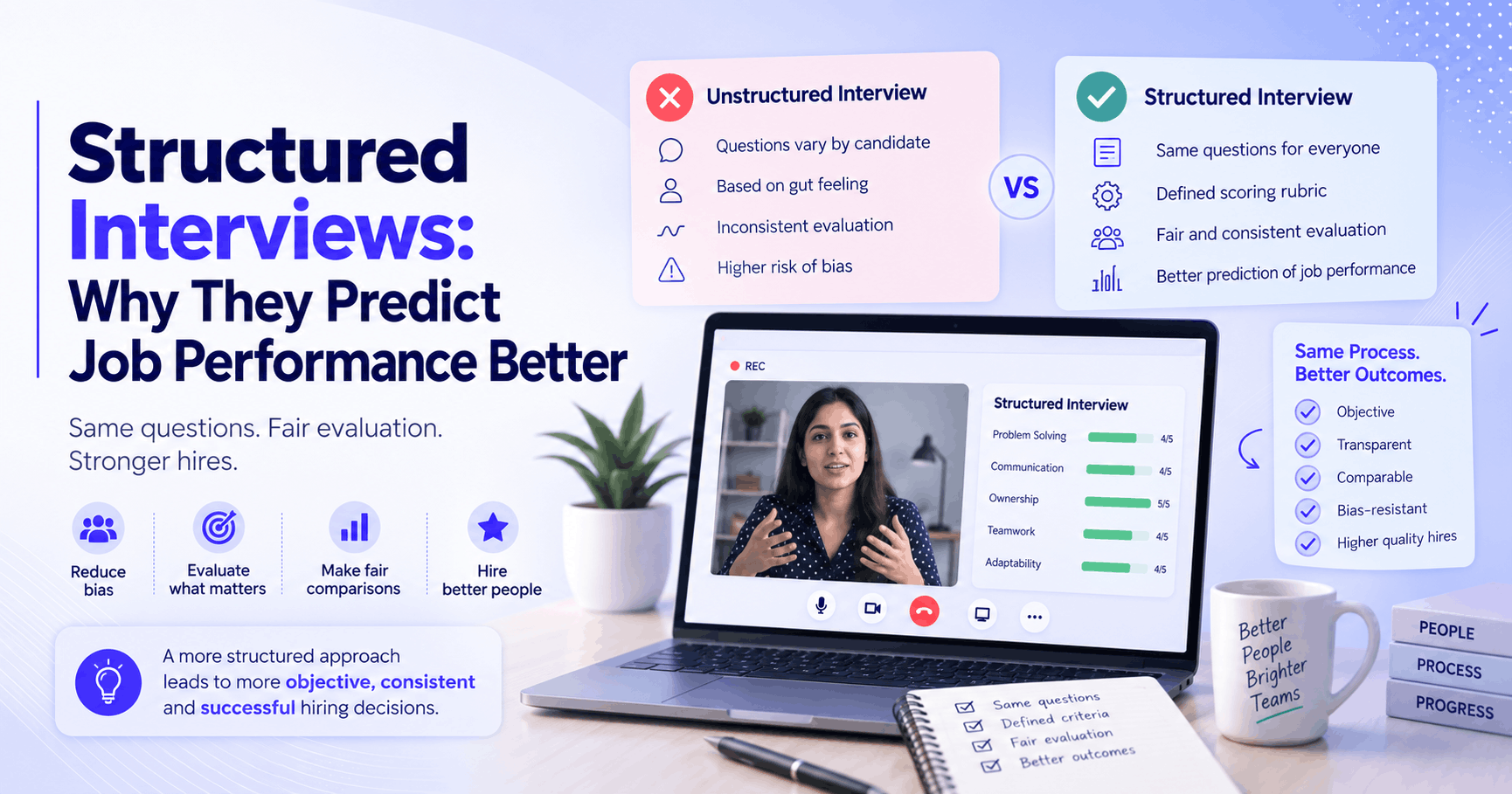
Structured interviews — a consistent set of pre-planned questions, asked the same way to every candidate, scored against a defined rubric — are less charming than a free-flowing conversation, but they consistently outperform unstructured interviews on the metric that actually matters: predicting real job performance. This post covers why that gap exists, how to actually build a structured interview, and how to keep it from feeling robotic in practice.
What the research actually shows
Decades of industrial-organizational psychology research on hiring have converged on a fairly consistent finding: structured interviews are meaningfully more predictive of on-the-job performance than unstructured, free-form conversations. The reasons are fairly intuitive once you look at what unstructured interviews actually measure, often unintentionally: how comfortable a candidate is with casual conversation, how quickly rapport builds with a specific interviewer, and how confidently a candidate can improvise an answer on the spot — none of which reliably predicts whether someone will actually perform well in the role itself.
Structured interviews close this gap by asking every candidate the same, carefully chosen questions, and scoring responses against pre-defined criteria tied to what the role actually requires — which produces genuinely comparable data across candidates, rather than each interview effectively becoming a different, unstandardized conversation.
Structured vs. unstructured: what actually changes
Unstructured interview: Questions vary by candidate, often improvised in the moment based on how the conversation flows. Evaluation is largely gut-feel — "I got a good feeling about them" — without a consistent, explicit standard being applied. Different interviewers may focus on entirely different things when evaluating the same candidate.
Structured interview: A pre-defined set of questions, ideally tied to specific competencies the role requires, asked in the same way (or close to it) to every candidate. Responses are scored against a defined rubric, often on a numeric scale with specific anchors describing what a strong, average, or weak answer actually looks like. Multiple interviewers evaluating the same candidate are working from the same standard, which makes their scores genuinely comparable.
This doesn't mean structured interviews eliminate all conversation or follow-up questions — a well-run structured interview still allows for genuine follow-up to clarify or dig deeper into an answer. What it removes is the randomness of entirely different questions and entirely different evaluation standards being applied to different candidates for the same role.
Why structured interviews reduce bias, not just improve prediction
Unstructured interviews give unconscious bias considerably more room to operate. When there's no consistent standard, an interviewer's overall impression — shaped by affinity bias, first impressions, or unrelated factors like confidence or communication style — fills the gap left by the absence of defined criteria. A structured format, with specific questions tied to specific competencies and a defined scoring rubric, gives bias less space to quietly substitute for genuine evaluation, because there's an explicit standard to evaluate against instead of an open-ended overall impression.
Structured interviews give bias less space to quietly substitute for genuine evaluation.
This is part of why structured interviews show up consistently in bias-reduction research alongside their performance-prediction benefits — the two effects are closely related, since both stem from replacing an unconstrained, easily-biased judgment with a consistent, defined standard.
How to actually build a structured interview
1. Start from the competencies the role actually requires
Before writing questions, define what genuinely matters for success in the role — not a generic list, but specific, observable competencies. For a sales role, this might include consultative questioning skills, resilience with rejection, and pipeline management discipline. For an engineering role, it might include systematic debugging approach, code quality judgment, and collaboration under ambiguity. This step connects directly to writing a clear job description in the first place — a role with well-defined, specific requirements makes building a structured interview considerably more straightforward than one with a vague, generic list.
2. Write specific questions tied to each competency
For each competency, write one or two questions designed to actually surface evidence of it — most effectively through behavioral questions ("tell me about a time you...") rather than hypothetical ones ("what would you do if..."), since past behavior tends to predict future behavior better than a candidate's theoretical answer to a scenario they haven't actually lived through.
Example, for "resilience with rejection" in a sales role: "Tell me about a deal you worked hard on that ultimately fell through. What happened, and what did you do afterward?"
Example, for "systematic debugging approach" in an engineering role: "Walk me through a particularly difficult bug you tracked down. How did you approach figuring out what was actually wrong?"
3. Define what a strong, average, and weak answer actually looks like
For each question, before interviewing anyone, write out specific anchors describing what a genuinely strong response demonstrates, what an average one looks like, and what a weak one looks like. This is the step teams most often skip, and it's arguably the most important one — without pre-defined anchors, "scoring" an answer on a 1-5 scale still leaves enormous room for inconsistent, essentially unstructured judgment disguised as a number.
4. Train interviewers on the rubric, not just the questions
Handing an interviewer a list of questions without walking through the scoring rubric and what "strong" versus "weak" actually looks like tends to produce inconsistent application even with the same questions being asked. A short calibration session — reviewing a sample answer together and discussing how it would be scored and why — meaningfully improves consistency across interviewers.
5. Score independently before discussing as a group
Have each interviewer score their assigned questions independently, before any group discussion of the candidate. Discussing first allows the most vocal or senior interviewer's opinion to unduly anchor everyone else's assessment — independent scoring first, followed by discussion, produces genuinely more independent input from each interviewer.
6. Allow for genuine follow-up, without abandoning structure
A structured interview isn't a rigid script that leaves no room for judgment — a good interviewer still probes for clarity, asks a natural follow-up if an answer is vague, and adapts tone to the individual candidate. What stays consistent is the core question set and the scoring standard, not necessarily every single word of the conversation.
Common objections, addressed honestly
"This feels robotic and impersonal." A structured interview doesn't have to feel like reading from a script verbatim — the structure lives in the core questions and scoring standard, not necessarily in a rigid, word-for-word delivery. Interviewers can still build rapport, add natural transitions, and respond genuinely to what a candidate says, while still asking the same core competency-based questions of every candidate.
"We lose the ability to read chemistry or gut feel." This is a real trade-off worth being honest about, not dismissed. The research consensus is that "gut feel" alone is a weaker predictor of performance than structured evaluation, but that doesn't mean interpersonal fit is irrelevant — it means fit should be assessed through specific, defined criteria (how someone describes collaborating with others, handling disagreement, communicating under pressure) rather than an unstructured, hard-to-articulate impression that's more susceptible to bias.
"This takes more time to set up than we currently spend." True, and worth acknowledging directly — building competency definitions, questions, and rubrics takes real upfront effort per role. The payoff is a process that's genuinely more predictive and more defensible, and once built, a structured interview guide can typically be reused across future openings for the same role type, reducing the marginal effort for subsequent hires.
"Different roles need different approaches — this won't work everywhere." Structured interviews absolutely need to be tailored per role — the competencies and questions for a senior engineering role look nothing like those for a customer support role, and that's expected. What stays consistent across roles isn't the specific content, it's the underlying discipline: define competencies first, build questions and scoring anchors deliberately, and apply them consistently to every candidate for a given opening.
A worked example: building one question set from scratch
It helps to see the full process applied to one role. Suppose you're building a structured interview for a mid-level customer success manager role. Start by identifying three or four core competencies: proactive communication, problem de-escalation under pressure, and the ability to translate customer feedback into actionable internal input. For "problem de-escalation," a behavioral question might be: "Tell me about a time a customer was genuinely upset with something your company did. Walk me through exactly what you said and did." The scoring anchors for this question might define a strong answer as one that shows the candidate acknowledged the customer's frustration specifically (not generically), took ownership of what was within their control, and followed up afterward to confirm resolution — while a weak answer might show defensiveness, vague deflection, or no follow-through described at all. Written out this specifically, two different interviewers reviewing the same candidate's answer are considerably more likely to arrive at similar scores than if they were each relying on an unstated, personal sense of what a "good" answer sounds like.
Adapting structured interviews for different interview formats
The core principles apply whether an interview happens live, over video, or asynchronously. For live or video interviews, the interviewer follows the same question set and scoring rubric as described above, with room for natural follow-up. For asynchronous, recorded formats — increasingly used for high-volume, first-round screening — the same underlying discipline matters even more, since there's no live interviewer to naturally add helpful context; the questions themselves need to be clear enough to stand entirely on their own, and the scoring rubric needs to be explicit enough that a reviewer (human or automated) evaluating the recording later has the same specific standard to apply that a live interviewer would have used in the moment.
How this connects to interview scheduling and feedback collection
Structured interviews work best when the surrounding process supports them — consistent scoring only helps if feedback from multiple interviewers actually gets collected and compared in one place, rather than scattered across separate emails or left in individual memory. A shared pipeline where interview feedback is logged directly against each candidate's record makes it considerably easier to actually compare structured scores across interviewers and catch inconsistencies, compared to trying to reconstruct scattered feedback after the fact. Getting the logistics right — consistent scheduling so every candidate for a role goes through a similar timeline and process — also supports the fairness goal structured interviews are built around, since inconsistent scheduling and process timing can itself introduce subtle differences in how candidates experience and perform in an interview.
A short checklist before your next interview cycle
- Are competencies for the role defined specifically, tied to what actually predicts success, rather than a generic list?
- Does each competency have at least one behavioral question designed to surface real evidence of it?
- Are scoring anchors written out in advance — what does a strong, average, and weak answer actually look like for each question?
- Have interviewers been walked through the rubric together, not just handed a question list?
- Does the process require independent scoring before group discussion of a candidate?
- Is feedback captured consistently enough that scores across interviewers can actually be compared afterward?
The bottom line
Structured interviews trade a little bit of conversational spontaneity for meaningfully better prediction of actual job performance and meaningfully reduced room for unconscious bias to operate — a trade-off the research consistently supports, even though it takes more upfront discipline to build well. The core idea is simple even if the execution takes real effort: define what actually matters for the role, ask every candidate about it consistently, score against a standard defined in advance, and let genuine follow-up happen within that structure rather than instead of it.