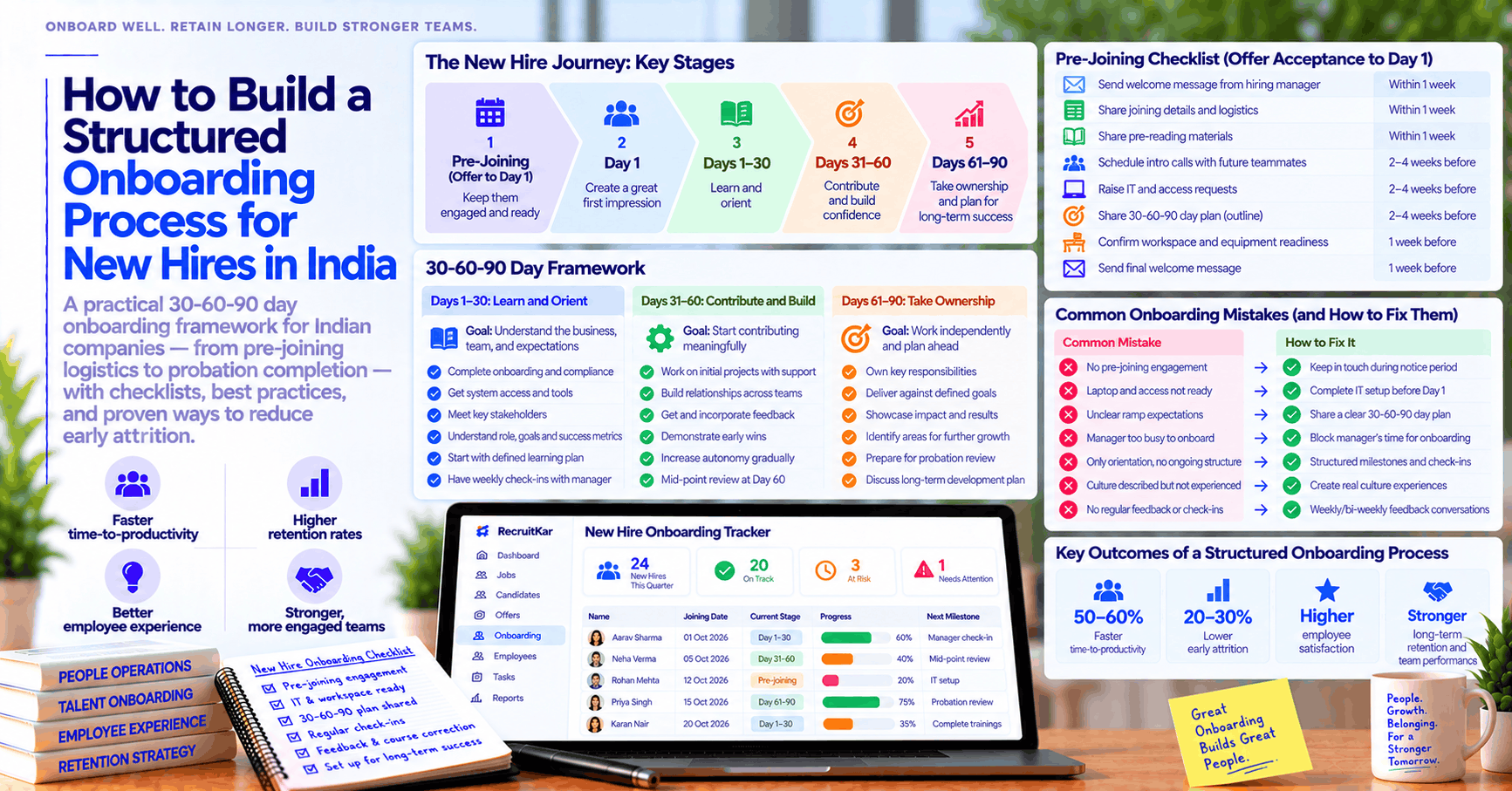
Onboarding failure in India has a specific shape: a new hire joins with genuine enthusiasm, spends their first week waiting for a laptop and trying to figure out who to ask for basic information, and by the end of Month 2 has quietly concluded that the role is less interesting than the interview implied. By Month 4 they're interviewing elsewhere, and by Month 6 you're running the same hire again. The cost of this — recruiting, notice period, re-interviewing, re-onboarding — is consistently underestimated because it's invisible in most hiring metrics. A structured onboarding process with a clear 30-60-90 day plan is the highest-ROI retention investment most Indian companies aren't making. RecruitKar's startup hiring platform tracks the transition from offer acceptance through joining — so the handoff from recruiting to onboarding is clean and documented, not reconstructed from email threads.
Why Indian onboarding specifically fails
Before the framework, it's worth being honest about the specific ways Indian company onboarding tends to break — because the fixes are different depending on which failure mode applies.
The pre-joining gap is unmanaged. In India, notice periods of 60–90 days mean a new hire is in a waiting period for weeks or months before joining. Most companies treat this as administrative dead time — a few forms to fill in, a joining date confirmation, and then silence. This is exactly the window when counter-offers happen and when second thoughts accumulate. A deliberate pre-joining engagement plan keeps the new hire emotionally connected to the new opportunity during a period when their current employer has ample opportunity to keep them.
Equipment and access aren't ready on Day 1. A new hire who arrives on their first day and spends it waiting for a laptop, chasing IT for system access, or sitting without a proper desk receives a clear message about how the organisation operates. Day 1 readiness requires deliberate advance work — not the assumption that things will sort themselves out.
There is no defined ramp expectation. Most Indian onboarding stops at orientation — the first week of introductions, paperwork, and tool access. What follows is typically sink-or-swim: the new hire is given work and expected to figure out how to do it, what the standards are, who to ask, and what good looks like. Without explicit milestones, most managers default to an evaluative stance rather than a supportive one.
The manager is too busy to onboard. The person most critical to a successful onboarding is typically the busiest person in the new hire's immediate network. Building the manager's onboarding responsibilities into their calendar as mandatory, scheduled commitments — not optional when time allows — is what makes the difference between onboarding that happens in theory and onboarding that happens in practice.
Culture is described but not experienced. Many Indian companies tell new hires about the company's culture. Far fewer create experiences that let a new hire actually feel and participate in the culture during their first weeks. A new hire who has been told "we value autonomy" but can't get a decision approved without three layers of sign-off has received contradictory information; the behaviour is what they'll believe.
The pre-joining phase (offer acceptance to Day 1)
This phase is almost entirely absent from most Indian onboarding programs and is the highest leverage place to intervene on early attrition for companies with long notice periods.
Week 1 after offer acceptance
Send a warm welcome message from the hiring manager (not just HR) — personal, brief, specific to what the new hire will be working on
Confirm logistics clearly: reporting location and time on Day 1, who to report to, parking or transport information if relevant, dress code if there's any ambiguity
Share onboarding materials that benefit from being read before Day 1: company overview, team structure, product or service basics
2–4 weeks before joining
Schedule a casual intro call with 1–2 direct teammates before Day 1 — an informal 20-minute conversation with future colleagues consistently reduces anxiety and accelerates the relationship-building that makes the first few weeks feel less isolating
Submit the tools and access request to IT well in advance so Day 1 equipment is ready
Confirm the 30-60-90 day plan in outline — the new hire should know before they join what the first 90 days are designed to achieve
1 week before joining
IT readiness check: Is the laptop provisioned? Are system accesses requested?
Workspace readiness: Is there a clear desk and working setup?
A brief message from the direct manager about what they're looking forward to working on together
The 30-60-90 day onboarding framework
Days 1–30: Learn and orient
The goal of the first month is not productivity — it's orientation. A new hire pressured to produce output in Week 1 before they understand context, tools, team dynamics, and standards is being set up to produce the wrong output quickly and then spend time correcting it.
Milestone outcomes by Day 30:
Understands company structure and how their function connects to outcomes
Has met every direct team member and 3–5 cross-functional stakeholders they'll work with regularly
Has working access to all primary tools and systems
Has completed mandatory training or certification requirements
Has a clear written understanding of their role's key responsibilities and what success looks like
Has had at least two 1:1s with their direct manager
Manager responsibilities in Month 1:
Week 1: Personal introduction to the team, role context walkthrough, first 1:1
Weeks 2–3: Regular check-in on orientation progress, any blockers surfaced and resolved
End of Month 1: Formal 30-day check-in — how is the new hire finding the role? Is anything surprising or confusing?
Days 31–60: Apply and contribute
The goal of Month 2 is first real contribution. The new hire should be doing actual work — not shadowing or observing — with appropriate support and explicit feedback.
Milestone outcomes by Day 60:
Has completed at least one substantive piece of work reflecting the actual job
Has received specific, constructive feedback on that work from their manager
Understands the team's working norms — how decisions are made, how work is reviewed
Has raised any concerns about role fit, resource gaps, or unclear expectations
Manager responsibilities in Month 2:
Assign real work with a clear brief and explicit quality standard
Review and provide specific feedback — not "good job" but what was strong and what to do differently
Mid-month check-in: are there early signals of mismatch worth addressing proactively?
Days 61–90: Perform and calibrate
The goal of Month 3 is calibration — establishing whether the hire is on track, surfacing any gaps early enough to address them, and setting the trajectory for probation completion.
Milestone outcomes by Day 90:
Has demonstrated core competencies at a level consistent with the experience level hired for
Has a clear picture of development areas and available support
Has an agreed performance plan extending beyond the 90-day period
Has had an explicit conversation with the manager about probation status — not an assumption, a direct discussion
Manager responsibilities in Month 3:
Formal 90-day review: structured, documented, specific
Probation status conversation: on track for confirmation? If not, what needs to change, in what timeframe, with what support?
Development planning: what does Year 1 look like from here?
The onboarding checklist
Pre-joining:
[ ] Welcome message sent by hiring manager within 24 hours of offer acceptance
[ ] Day 1 logistics confirmed
[ ] Onboarding materials shared
[ ] Pre-joining team intro call scheduled
[ ] IT equipment and access request submitted
[ ] 30-60-90 day plan drafted and shared in outline
Day 1:
[ ] Laptop and systems access ready
[ ] Workspace assigned
[ ] Team introductions completed
[ ] Manager 1:1 scheduled for Week 1
Week 1:
[ ] HR documentation completed
[ ] Company and role orientation completed
[ ] First manager 1:1 held
[ ] Cross-functional introductions scheduled
Month 1:
[ ] All tool access fully provisioned
[ ] Mandatory training completed
[ ] 30-day check-in held and documented
[ ] First deliverable assigned
Month 2:
[ ] First substantive deliverable completed and reviewed
[ ] Specific feedback given
[ ] Working norms understood and applied
Month 3:
[ ] 90-day formal review held and documented
[ ] Probation status conversation held
[ ] Development plan agreed
[ ] Post-probation objectives set
What good onboarding looks like for remote hires
Remote onboarding in India has additional friction points that don't apply to in-office onboarding:
Equipment delivery: Laptop shipped to the hire's location before Day 1 — not dispatched on Day 1. This requires the onboarding process to trigger logistics 1–2 weeks before joining.
Digital-first introductions: 1:1 video calls with teammates and stakeholders, scheduled explicitly — 15–20 minutes each — across the first two weeks. These don't happen organically without a shared office.
Over-communication of context: In an office, a new hire absorbs context passively. A remote new hire receives none of this passive context and needs it delivered deliberately through documentation and structured check-ins.
Extra manager proactivity: A remote manager who is "available on Slack" but not proactively scheduling check-ins creates isolation, not accessibility.
How onboarding connects to hiring quality
The single most common cause of early attrition — a new hire leaving within 6 months — is role mismatch: the role turned out to be meaningfully different from what was communicated during hiring. This is both a hiring problem and an onboarding problem. The hiring process is responsible for accurate role representation; the onboarding process is responsible for surfacing and addressing misalignments early enough to fix them.
The 30-day check-in is the highest-value early warning system available. A new hire who at Day 30 describes their role as different from expectations is surfacing something fixable — a scope clarification, a project reassignment, a manager conversation. The same new hire at Day 180, now updating their Naukri profile, is not fixable through onboarding.
This is also why the pipeline handoff from recruiting to onboarding matters. The context gathered during hiring — what the candidate was told the role involves, what they said they were most excited about, what compensation was discussed — should be accessible to the onboarding manager, not trapped in the recruiter's email history. A visual ATS pipeline where every candidate conversation, offer detail, and joining note is documented creates exactly this handoff without the archaeology.
Frequently asked questions
What is the biggest cause of early attrition in India in the first 6 months? Role mismatch — the new hire experiences a role meaningfully different from what was communicated during the interview process — is consistently among the top causes alongside compensation surprise and manager relationship breakdown. The 30-day check-in is the highest-value intervention point: it surfaces misalignments early enough to address them rather than discovering them at a 6-month exit interview.
How long should onboarding take? The formal structured onboarding period should run through probation completion — typically 3 or 6 months depending on company policy. The most intensive phase is the first 30 days; the subsequent 60 days are progressively more about performance and less about orientation. "Onboarding is complete" should coincide with probation confirmation and agreed first-full-cycle objectives, not with the first week or first month.
Should onboarding differ for senior hires versus junior hires? Yes, significantly. Junior hires need more structured process guidance — how to do things, explicit tool training, hands-on support. Senior hires need more context — why things work the way they do, who the key stakeholders are, what the political landscape looks like — and more autonomy to develop their own approach. Both benefit from explicit 30-day and 90-day milestone conversations; the content differs by seniority.
What is HR's role versus the manager's role in onboarding? HR owns the compliance and process layer: documentation, system access, mandatory training, probation tracking, and pre-joining logistics. The manager owns the work layer: role context, first assignments, feedback, performance check-ins, and the development conversation at 90 days. The most common failure is HR completing its layer and assuming onboarding is done — when the manager layer, where real integration happens, was never activated.
How do we measure whether our onboarding is working? Track early attrition rate (separations within 6 months of joining) by cohort. Supplement with a new hire satisfaction survey at 30 and 90 days — 2 or 3 specific questions: "Do you have what you need to do your job?", "Are you clear on what success looks like in your role?", "Is the role matching what you expected from the interview?" The 30-day survey in particular is the highest-value early warning system — it surfaces problems while they can still be fixed.
From offer acceptance to Day 1 joining — track it all in one place. RecruitKar logs every offer detail, joining date, and candidate note so the onboarding manager inherits the full context, not a blank slate. Startup hiring platform + visual ATS pipeline — clean handoff from recruiting to onboarding.