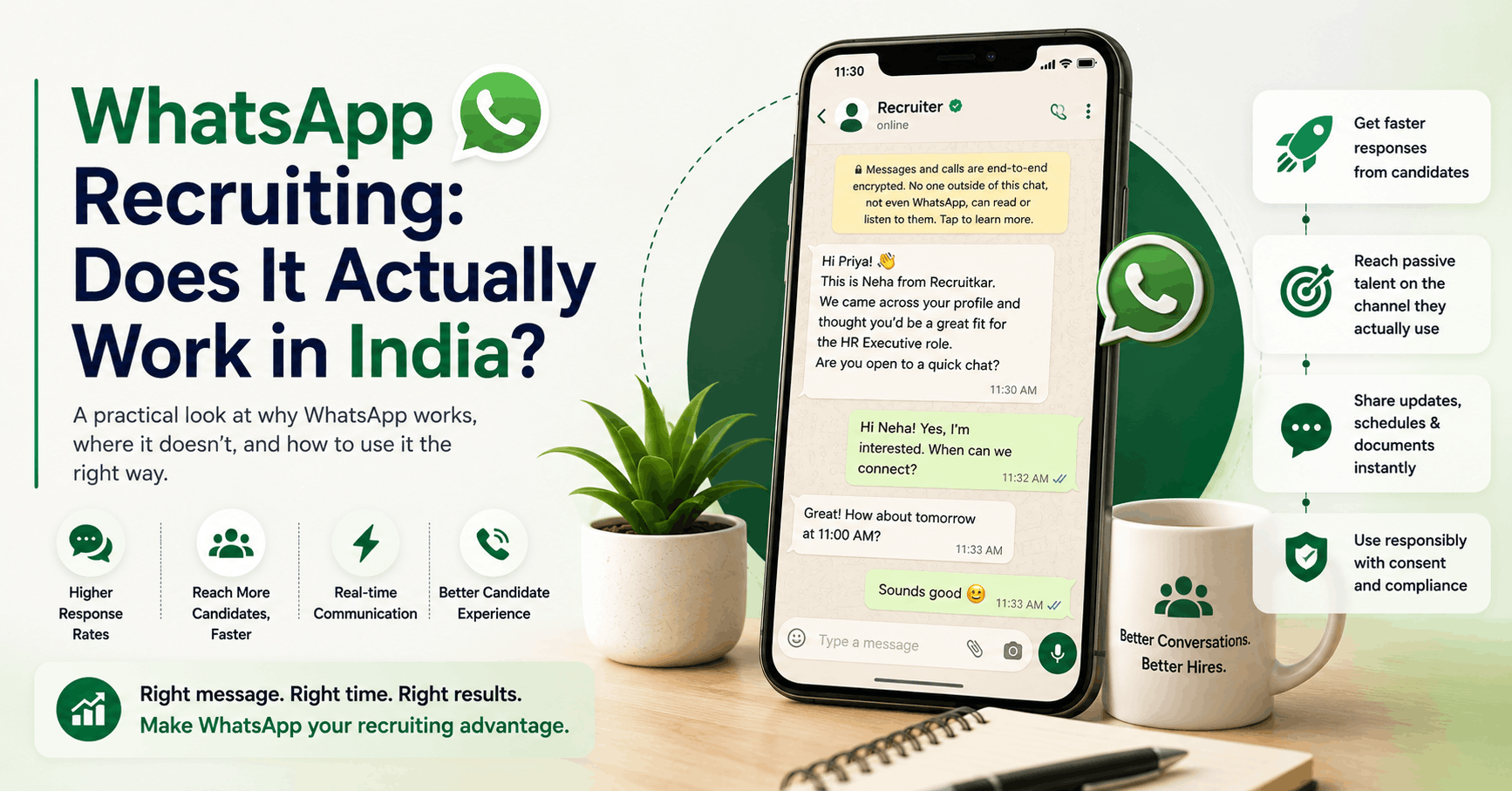
Most recruiters in India have had this experience: a candidate looks genuinely engaged after an interview, agrees enthusiastically to next steps, and then goes completely silent when the follow-up email lands in their inbox. Days pass. No reply. The recruiter assumes the candidate lost interest — and then a WhatsApp message, sent almost as an afterthought, gets a response within the hour.
This isn't a coincidence, and it isn't unique to any one company's candidates. It reflects something specific about how people in India actually use their phones — and it's why WhatsApp has quietly become a serious recruiting channel rather than a workaround. This post looks at why it works, where it doesn't, and how to use it without creating new problems (spam fatigue, compliance risk, unprofessional impressions) in the process.
Why WhatsApp specifically, and why in India
WhatsApp's dominance in India isn't marginal — it's the primary messaging app for hundreds of millions of people, spanning far more of the population, across far more age groups and geographies, than any single email provider or professional network. That matters for recruiting in a very specific way: candidates check WhatsApp constantly, throughout the day, in a way they simply don't check a job-application inbox or a professional network they log into occasionally.
Email, by contrast, has a structural disadvantage for time-sensitive recruiting communication. It competes with newsletters, notifications, and other noise, and a message from an unfamiliar sender is easy to miss or deprioritize — particularly for passive candidates who aren't actively checking their inbox for job opportunities. WhatsApp doesn't have the same noise problem for most users, and a message there tends to get noticed almost immediately, simply because of how habitually people check the app.
This is especially relevant for two groups Indian recruiters deal with constantly: high-volume, entry-level, or blue-collar hiring, where candidates may not check email regularly at all, and passive candidates, who are unlikely to open a cold email but will often glance at a WhatsApp message out of simple habit.
Where WhatsApp genuinely outperforms other channels
- Response speed. The single biggest practical advantage is how quickly candidates respond compared to email — often within the same day, sometimes within minutes, versus email threads that can sit unanswered for days.
- Reaching candidates without reliable email habits. A significant portion of India's workforce — particularly in retail, manufacturing, logistics, and other high-volume sectors — doesn't check email regularly, if they have a professional email address at all. WhatsApp reaches these candidates on a channel they actually use daily.
- Low-friction, informal communication that still feels personal. A short WhatsApp message asking "are you still interested in the role?" reads as direct and human in a way a formal email template often doesn't — which can actually improve candidate experience rather than cheapening it, if it's done thoughtfully.
- Practical logistics. Sending an interview address, a reminder an hour before a call, or a quick document request is simply faster over WhatsApp than composing and sending an email for something that would otherwise be a two-line message.
Where it doesn't work, or actively backfires
- Formal, detailed communications. Offer letters, detailed compensation breakdowns, or anything requiring a documented paper trail still belongs in email (or a formal letter) — WhatsApp is a poor channel for anything that needs to be a permanent, easily-referenced record.
- Over-messaging. Because WhatsApp feels personal and immediate, it's tempting to over-use it — multiple follow-ups in a single day, messages outside working hours, or generic mass messages that feel like spam. This is the fastest way to burn the exact advantage that makes WhatsApp effective: candidates who feel spammed stop responding, and worse, may report the number or block it entirely.
- Senior or executive candidates. For more senior roles, a cold WhatsApp message can come across as presumptuous or unprofessional, particularly for candidates not actively looking — email or LinkedIn tends to be a better first-touch channel here, with WhatsApp reserved for later, once a relationship is established.
- Without consent. Messaging someone on WhatsApp who never provided that number for recruiting purposes, or who explicitly asked not to be contacted there, is both a poor candidate experience and a genuine compliance risk (more on this below).
Practical dos and don'ts
- Do get explicit consent before moving a conversation to WhatsApp. If a candidate applies through a job board or careers page, don't assume their listed phone number is fair game for WhatsApp outreach — ask, or use it only after they've engaged with you through another channel first.
- Do keep messages short and specific. WhatsApp is not the channel for a long job description or a detailed pitch — that's what email or a call is for. Use it for the specific, time-sensitive things it's actually good at: a quick check-in, a scheduling confirmation, a document request.
- Do respect working hours, mostly. While WhatsApp's informality means slightly more flexibility than a strict 9-to-5 email policy, sending messages at 11pm or on a Sunday still reads as inconsiderate to a lot of candidates — treat it with roughly the same courtesy as a phone call, not a background notification.
- Do personalize, don't template-blast. A message that's obviously copy-pasted to a hundred people, especially without even the candidate's name inserted correctly, undermines the exact personal-feeling advantage that makes WhatsApp effective in the first place.
- Don't use it as your only channel. Some candidates genuinely prefer email or don't have WhatsApp active on the number they've shared — sequencing across channels rather than relying on WhatsApp alone still produces the best overall response rate. Tools that combine WhatsApp with email and voice outreach in one sequence — rather than requiring a recruiter to manually track who's been contacted where — tend to handle this better than a single-channel approach.
- Don't skip the paper trail for anything formal. Confirm interview details or an offer over WhatsApp if useful for speed, but always follow up with a written record via email for anything that might matter later — compensation details, start dates, formal offer terms.
Compliance and consent, taken seriously
This is worth treating carefully rather than glossing over, since WhatsApp recruiting sits in a bit of a gray area a lot of teams don't think through:
- Where did the number come from? A number a candidate provided directly on a job application is different from a number sourced from a public profile or purchased list — the latter raises real consent concerns.
- Is there an opt-out, and is it respected? If a candidate asks to stop being contacted on WhatsApp, that request needs to be honored immediately and consistently, not just for that one recruiter's outreach.
- Is messaging volume reasonable? Regulatory attention on unsolicited commercial messaging in India has increased over time, and while recruiting outreach to an engaged candidate is a different category from spam, treating consent and frequency carelessly increases both compliance risk and the risk of being blocked or reported.
- Is sensitive information being sent appropriately? Avoid sending anything highly sensitive (detailed compensation, personal identification numbers) over WhatsApp if it wouldn't be appropriate to send over unencrypted SMS — WhatsApp messages are encrypted in transit, but that doesn't mean every kind of information belongs there.
Building these guardrails into a WhatsApp outreach process from the start is far easier than retrofitting them after a candidate complaint.
What this looks like in an actual recruiting workflow
A reasonably well-designed use of WhatsApp in a hiring process might look like this: initial outreach goes out by email (a slightly more formal, expected first touch for most professional roles), with a WhatsApp follow-up two or three days later if there's no response — since a second touch on a channel the candidate actually checks often succeeds where the first didn't. Once a candidate has responded and a relationship is established, WhatsApp becomes the default for scheduling confirmations, quick questions, and day-of reminders, while anything formal (offer details, documentation requests) stays in writing over email.
This kind of sequenced, multi-channel approach — rather than picking one channel and using it exclusively — tends to outperform either channel alone, since it reaches candidates on whichever channel they're actually most likely to be paying attention to at that moment. Platforms built for the Indian market increasingly support this natively: Recruitkar's outreach tools, for instance, combine email, WhatsApp, and AI voice calling in a single sequence tracked through one inbox, so a recruiter isn't manually managing which candidate got contacted on which channel and when.
What the response-rate gap actually looks like
It's worth being concrete rather than just asserting "WhatsApp works better." In practice, recruiters running both channels side by side for the same candidate pool typically see WhatsApp messages opened and responded to within hours, often the same day, while a comparable email — sent to the same candidate, at the same stage of the process — can sit unopened for two or three days, if it gets a response at all. The gap tends to be largest for two groups specifically: candidates who aren't actively job-hunting (passive candidates, who have little reason to be checking a job-related inbox) and candidates in roles where a professional email habit was never really established in the first place. For candidates who are actively engaged and checking email regularly — often more senior, white-collar candidates already mid-process — the gap narrows considerably, which is part of why channel choice should depend on who you're actually reaching, not a blanket rule.
Measuring whether it's actually working for your team
Rather than assuming WhatsApp is helping based on anecdote, it's worth tracking a few simple numbers over a month or two: response rate and average response time on WhatsApp versus email for the same stage of outreach, and — just as importantly — opt-out or block rates, which is the clearest signal that message frequency or content has crossed from helpful into intrusive. If response rates are strong but opt-outs are climbing, that's usually a sign of over-messaging rather than a reason to abandon the channel; tightening frequency and personalization typically fixes it faster than switching channels entirely.
Writing WhatsApp messages that actually get replies
A few concrete habits separate WhatsApp outreach that works from outreach that gets ignored (or blocked):
- Lead with the specific reason you're messaging, not a generic greeting — "Following up on the [Role Name] application you submitted" gets read faster than "Hi, hope you're doing well!"
- Keep it to two or three sentences. If it needs to be longer than that, it probably belongs in an email instead.
- Ask one clear question or give one clear next step, rather than several — a message asking three things at once often gets a response to only one of them, or none.
- Identify yourself and the company by name in the first message, since an unfamiliar number with no context is more likely to be ignored or reported, regardless of intent.
- Match tone to the relationship stage. A first-touch message can be slightly more formal than a follow-up with someone already mid-process; going too casual too early can read as impersonal mass messaging rather than genuine outreach.
A few common questions
Is it unprofessional to message a candidate on WhatsApp? Not inherently — for a lot of Indian candidates, especially outside senior/executive roles, it's simply where they're most reachable. What makes it feel unprofessional is poor execution: over-messaging, sending it without consent, or using it for content it's not well suited to (long, formal communications).
Should recruiters use a personal WhatsApp number or a business one? A dedicated business number (via WhatsApp Business or an integrated outreach tool) is generally better practice than a personal number — it keeps a clear boundary, allows for template management and consent tracking, and doesn't expose a recruiter's personal contact to candidates indefinitely.
Does WhatsApp recruiting work for white-collar or corporate roles, not just high-volume hiring? Yes, though more selectively — it's less suited as a cold first-touch channel for senior candidates, but works well for logistics and scheduling once initial contact has been made through a more traditional channel.
What's the biggest mistake teams make when adopting WhatsApp for recruiting? Treating it like email — sending long, formal, templated messages at the same volume and cadence they'd use for email campaigns. That approach quietly erodes the exact advantage (feeling personal and immediate) that makes WhatsApp work as a recruiting channel in the first place.
The bottom line
WhatsApp recruiting works in India because it meets candidates where they actually are, not because it's a trendy channel to add for its own sake.
Used well — with real consent, sensible message volume, and reserved for the things it's genuinely good at — it consistently outperforms email on response speed and reach, especially for high-volume and passive-candidate hiring. Used carelessly, it just becomes another form of spam that candidates learn to ignore or block. The channel isn't the differentiator; how deliberately it's used is.