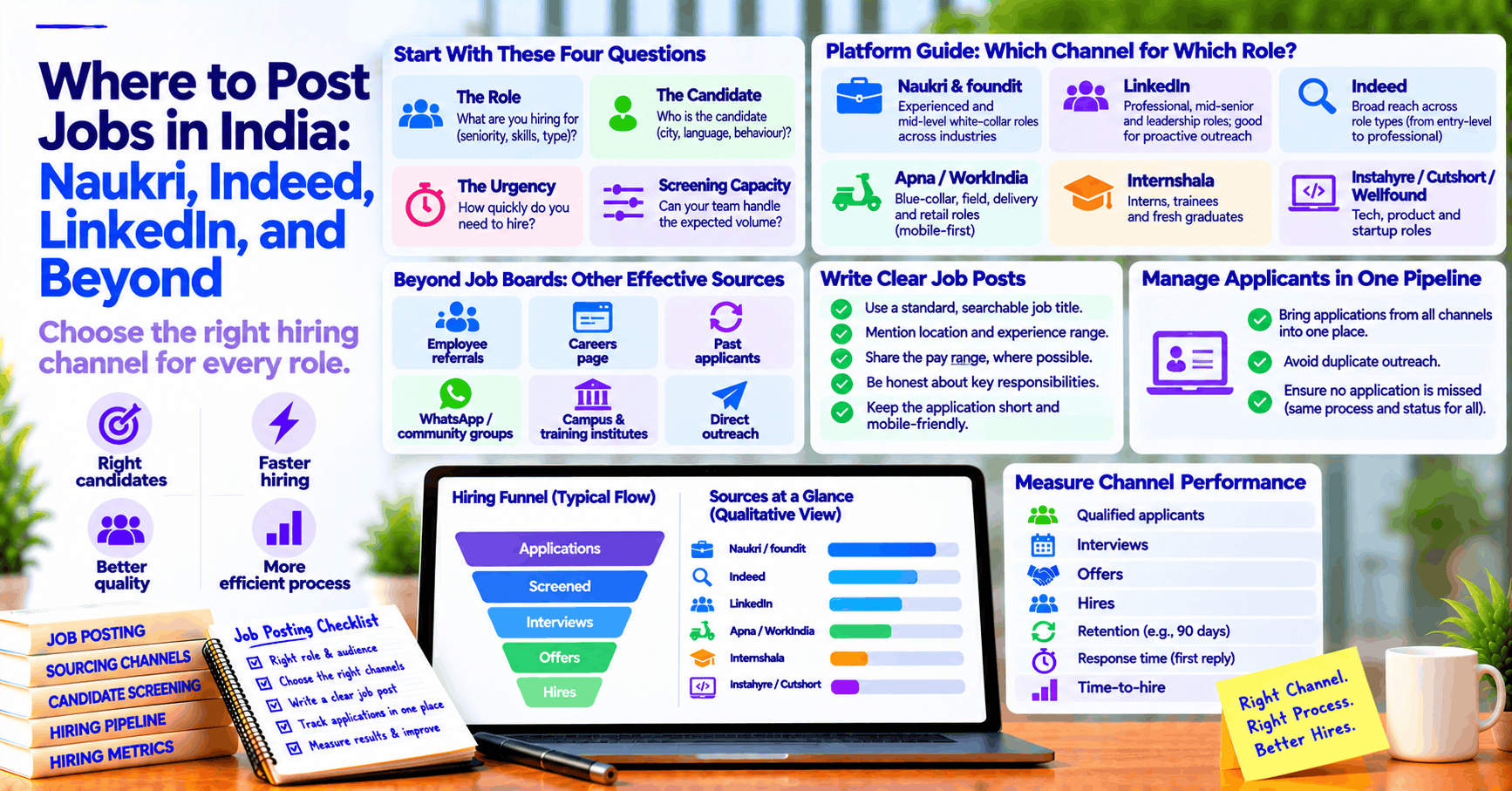
The best place to post a job in India depends on the role. Naukri and foundit suit many experienced white-collar hires, LinkedIn suits professional and senior roles, Indeed gives broad reach across role types, and job apps built for frontline work suit entry-level and field hiring. Most teams do better by combining two or three channels, then bringing every applicant into one place with RecruitKar's import from job boards. This guide explains how to choose, how the main options compare in general terms, and how to avoid drowning in scattered applications.
Start With the Role, Not the Portal
The most common mistake in job posting is picking a favourite portal and posting everything there. A warehouse supervisor, a senior backend engineer, and a fresher customer-support executive look for jobs in very different places. Before you pay for or post anywhere, answer four questions:
Who is the candidate? Think about seniority, city, language, and how they search for work. A candidate in a metro with six years of experience behaves differently from a school-leaver in a tier-3 town.
Where do they already look? Ask your recent hires how they found the job. Your own hiring history is more reliable than any generic ranking.
How fast do you need to hire? Urgent, high-volume roles need channels with quick response. Niche roles may need slower, more targeted channels.
What can you handle? A wide channel can bring hundreds of applications. If your team cannot screen them quickly, you will lose good candidates to slow replies.
Write the answers down per role family. This becomes your channel plan, and you can refine it as data comes in.
The Main Job Platforms at a Glance
The table below is a general, qualitative guide. Platforms change their features and positioning over time, so check each one's current offering before you commit budget. We have deliberately avoided pricing and traffic claims, because these shift often and vary by plan and region.
| Channel | Generally suits | Typical strengths | Things to watch |
|---|---|---|---|
| Naukri | Experienced and mid-level white-collar roles across industries | Familiar to many Indian job seekers; searchable resume database | Applications can be high in volume and mixed in quality |
| Indeed | A wide range of roles, from entry-level to professional | Broad reach; easy posting | Needs clear job titles and descriptions to attract the right people |
| Professional, mid-senior, and leadership roles; employer branding | Rich profiles; good for proactive outreach and referrals | Passive candidates may take longer to respond | |
| foundit and Shine | Experienced hires, especially where you want an additional resume database | Extra reach beyond the biggest names | Check overlap with other portals to avoid paying twice for the same audience |
| Frontline job apps (such as Apna or WorkIndia) | Blue-collar, field, delivery, retail, and entry-level roles | Built for mobile-first, quick-apply hiring | Quality varies, so screen quickly and verify |
| Fresher and internship platforms (such as Internshala) | Interns, trainees, and fresh graduates | Reach to early-career candidates | Candidates may have limited work history |
| Tech and startup communities (such as Instahyre, Cutshort, Wellfound) | Software, product, and startup roles | Targeted audiences who are open to tech opportunities | Smaller pools; competition for strong candidates is high |
No single row is the answer. The right mix depends on what you are hiring for.
Naukri: A Strong Default for Experienced White-Collar Hiring
For many Indian employers, Naukri is the first platform that comes to mind for hiring experienced professionals in sales, operations, finance, HR, IT services, and similar functions. Two things make it useful: job seekers across many industries already treat it as a place to look, and employers can both post jobs and search a resume database.
How to use it well:
Use clear, searchable job titles. Candidates search for "Accounts Executive," not an internal label like "Finance Rockstar."
Be specific about experience range, location, and key skills, because filters matter on both sides.
Search the resume database proactively instead of waiting only for inbound applications.
Respond quickly. Candidates on job portals are often applying to many roles at once.
Watch out for: a high volume of applications from people who do not meet basic criteria. Add screening questions, or use structured screening after import, so your team does not waste time on manual sorting.
Indeed: Broad Reach and Simple Posting
Indeed works as a broad channel that can serve many role types. Because job seekers search by role and location, the quality of your title and description matters a lot. A vague post gets lost, and a clear one is easier to match.
How to use it well:
Put the job title, location, and pay range (if you can share it) up front.
Keep descriptions scannable: key responsibilities, must-have skills, and what the day-to-day looks like.
Use it for volume roles where you want wide visibility, and combine it with a more targeted channel for niche hires.
Watch out for: treating it as set-and-forget. Review applicant quality after the first week, and edit the posting if the wrong people are applying.
LinkedIn: Best for Professional Roles and Employer Branding
LinkedIn is strongest when the role is professional, mid-senior, or leadership, and when candidates are likely to research your company before applying. It is also valuable for people who are not actively job hunting but would consider the right opportunity.
How to use it well:
Keep your company page current. Candidates often look at it before applying.
Encourage employees to share open roles. A post from a team member often gets more attention than a corporate announcement.
Combine posting with direct outreach. Searching profiles and sending personalised messages can reach people who would never see a job ad.
Write short, human outreach messages that explain why you are contacting this person specifically.
Watch out for: relying only on inbound applications for senior roles. For many leadership searches, proactive outreach does the heavy lifting.
foundit and Shine: Extra Reach for Experienced Hiring
foundit (formerly known as Monster India) and Shine are additional portals that many employers use alongside the larger names. They can be useful when you want more resume database coverage, or when a role is hard to fill and you want to widen the net.
How to use them well: treat them as supplements. Post the same role once on your primary portal, then test a second or third source and compare results. If a platform repeatedly sends the same candidates you already have, or does not send candidates who fit, reduce spend there and move budget elsewhere.
Frontline and Entry-Level Job Apps
For delivery partners, warehouse staff, store associates, drivers, security guards, and other frontline workers, mobile-first job apps often work better than traditional white-collar portals. These candidates typically search from a phone, may prefer regional languages, and want a fast, simple way to apply and hear back.
How to use them well:
Keep the job post short, with location, shift, pay structure, and joining timeline stated clearly.
Use simple language. Avoid corporate jargon.
Reach out fast, ideally the same day. Frontline candidates often accept the first reasonable offer they get.
Use messaging that matches how people communicate. Many frontline candidates respond more readily to WhatsApp or a phone call than to email. RecruitKar's WhatsApp outreach can help keep that follow-up fast and consistent.
Watch out for: no-shows and drop-offs between application and joining. Build a follow-up routine, and confirm interview and joining details by message and call.
Fresher and Internship Platforms
When you hire trainees, interns, or fresh graduates, platforms focused on early-career candidates can reach people that general portals may not. Campus partnerships also matter here: college placement cells, student communities, and alumni networks are often a better path than a general job ad.
How to use them well: state clearly what the role offers in terms of training, learning, and growth. Early-career candidates compare employers on these signals as much as on pay.
Niche Communities for Tech and Startup Roles
For software, product, data, and design roles, specialised platforms and communities can work better than broad portals. Many strong tech candidates look at curated platforms, developer communities, open-source contributions, and referrals before they check a general job board.
How to use them well: be specific about the tech stack, the team, and the problem the role solves. Technical candidates respond to clear, concrete descriptions more than to generic company boilerplate. If you are a smaller company, say what makes the role distinctive: ownership, learning, or the chance to build something from scratch. For small teams planning their first few hires, RecruitKar's startup solution shows how a lean team can organise sourcing and hiring in one place.
Beyond Job Boards: Channels Many Teams Underuse
Job portals are only one part of the picture. Several other channels often produce strong candidates at low cost.
Your own careers page. Candidates who visit your site are already interested. Keep your page simple, mobile-friendly, and easy to apply from.
Employee referrals. Current employees know who would fit. Make referrals easy to submit, and reward them fairly and promptly.
Your past applicants. Many people who applied before were good but arrived at the wrong time. Keep a searchable record and reach out when a similar role opens.
WhatsApp and community groups. For frontline and regional hiring, local groups and community networks can be very effective, provided you follow group rules and avoid spam.
Campus and training institutes. Colleges, polytechnics, ITIs, and skilling institutes can provide a steady flow of early-career talent.
Direct outreach. Contacting suitable people before they apply, by email, WhatsApp, or phone, reaches candidates who are not browsing job boards at all. RecruitKar's email outreach is one way to keep that messaging consistent and trackable.
A balanced plan usually includes one or two paid or portal channels, plus several low-cost channels you can run continuously.
How to Write a Job Post That Works on Any Platform
The platform matters, but the content of your post matters just as much. A few principles help everywhere.
Use a clear, standard job title. Candidates search using common titles. Put any internal title in the body of the description.
Open with what matters most. Location, experience level, and the core responsibility should appear in the first few lines.
Be honest about the role. Describe real responsibilities, working hours, and the reality of the work. Misleading posts create drop-offs, bad reviews, and early attrition.
Share pay information where you can. Many candidates skip posts that give no indication of pay. Even a range helps.
List must-haves separately from nice-to-haves. Long lists of requirements discourage qualified candidates, especially those who may be underrepresented in your applicant pool.
Keep the application process short. Every extra form field loses candidates. Ask only for what you need at the first stage.
Use inclusive language. Avoid wording that suggests a preferred gender, age, caste, religion, or marital status unless there is a genuine legal or occupational reason. See the note at the end of this article.
Managing Applicants Across Multiple Portals
Posting in several places solves the reach problem and creates a new one: applicants arrive in different inboxes, dashboards, and file formats. Without a single system, teams run into familiar issues.
The same candidate applies on two portals, and two recruiters contact them separately.
Good applicants sit in a portal inbox for days because nobody checked it.
You cannot tell which channel is actually producing hires.
Candidate data ends up in personal spreadsheets and email threads.
The fix is to pull applicants into one pipeline as soon as they arrive. With RecruitKar's import from job boards, you can bring candidates from your job board postings into a single place, so your team works from one list. Pair that with a visible pipeline, such as the RecruitKar ATS pipeline, and everyone can see who has been contacted, who is waiting, and who is moving to interview.
Once candidates are in one system, you can also respond faster, schedule interviews without back-and-forth through interview scheduling, and track results by source.
Measuring Which Channel Actually Works
A channel is only worth paying for if it produces hires you are happy with. Rather than relying on general rankings, track a few simple measures per role and per channel:
Applications received. How many people applied?
Qualified applicants. How many met your basic criteria?
Interviews and offers. How many moved forward?
Hires and retention. Who joined, and are they still doing well after the first few months?
Time to respond and time to hire. How quickly does your team act on candidates from this source?
Review these monthly. A channel that brings fewer applicants but more hires may be better than one that brings volume and noise. Over a few hiring cycles, your own data will tell you where to spend more and where to cut back.
Common Mistakes When Posting Jobs in India
Posting everywhere at once without a plan. More channels mean more applicants to manage. Add channels deliberately.
Copy-pasting the same description for every platform. A frontline job app and LinkedIn need different tone, length, and detail.
Ignoring mobile. Many candidates apply from phones. If your application takes too long on a small screen, you lose them.
Slow response. Candidates apply elsewhere while they wait. Reply within a day wherever possible.
Not closing old postings. Stale jobs frustrate candidates and distort your data. Close or refresh roles when they are filled.
Forgetting regional language. For many roles, a post in the local language performs better than an English-only one.
Treating the portal inbox as your ATS. Portals are for finding candidates. Managing them properly needs a pipeline.
A Note on Job Postings and Compliance
This article is for general information and is not legal advice. Job postings can touch on anti-discrimination expectations, pay transparency practices, contract and employment terms, and personal data of applicants. Have your legal counsel or HR compliance advisor review your posting templates, the data you collect from applicants, and how long you keep it. Also read each platform's current terms of use before copying or reusing candidate information outside the platform.
Frequently Asked Questions
1. Which is the best job portal in India for hiring?
There is no single best portal. Naukri and foundit are commonly used for experienced white-collar roles, LinkedIn for professional and senior roles, Indeed for broad reach, and mobile job apps for frontline hiring. The right choice depends on the role, the city, and the candidate. Ask recent hires where they found you, and test two or three channels before committing.
2. Is LinkedIn or Naukri better for recruiters in India?
It depends on the role. Many recruiters use Naukri for experienced mid-level hiring across industries and LinkedIn for professional, senior, and passive-candidate outreach. Rather than choosing one, compare results for your own roles over a few hiring cycles and keep the channel that produces more of the hires you want.
3. Where should I post blue-collar or frontline jobs?
Mobile-first job apps designed for entry-level and frontline roles are a common choice, along with referrals, local community groups, and walk-in drives. Keep the post short and in simple language, state pay and shift clearly, and follow up quickly by phone or WhatsApp, since frontline candidates often decide fast.
4. How many job portals should I use for one role?
Two or three is a practical starting point: one primary channel that fits the role, one supporting channel to widen reach, and one low-cost channel such as referrals or your careers page. More channels create more applicants to manage. Add another only when your team can respond to everyone quickly.
5. How do I manage applicants from different job boards in one place?
Bring applicants into a single pipeline as soon as they arrive, instead of working from each portal's inbox. A tool such as RecruitKar lets you import candidates from job boards into one list, track their stage, and avoid duplicate outreach. This also helps you see which source produces hires, so you can adjust your channel mix.
Final Thoughts
Choosing where to post jobs in India is less about finding the one perfect platform and more about matching the channel to the candidate. Start with the role, test a small mix of channels, write posts that are clear and honest, and respond quickly. Most importantly, keep all applicants in one pipeline so that nothing slips through and your data shows what is working.
If you want a single place to bring in applicants from your job postings, reach out to them, and move them through interviews, explore RecruitKar and see how it fits your hiring workflow.