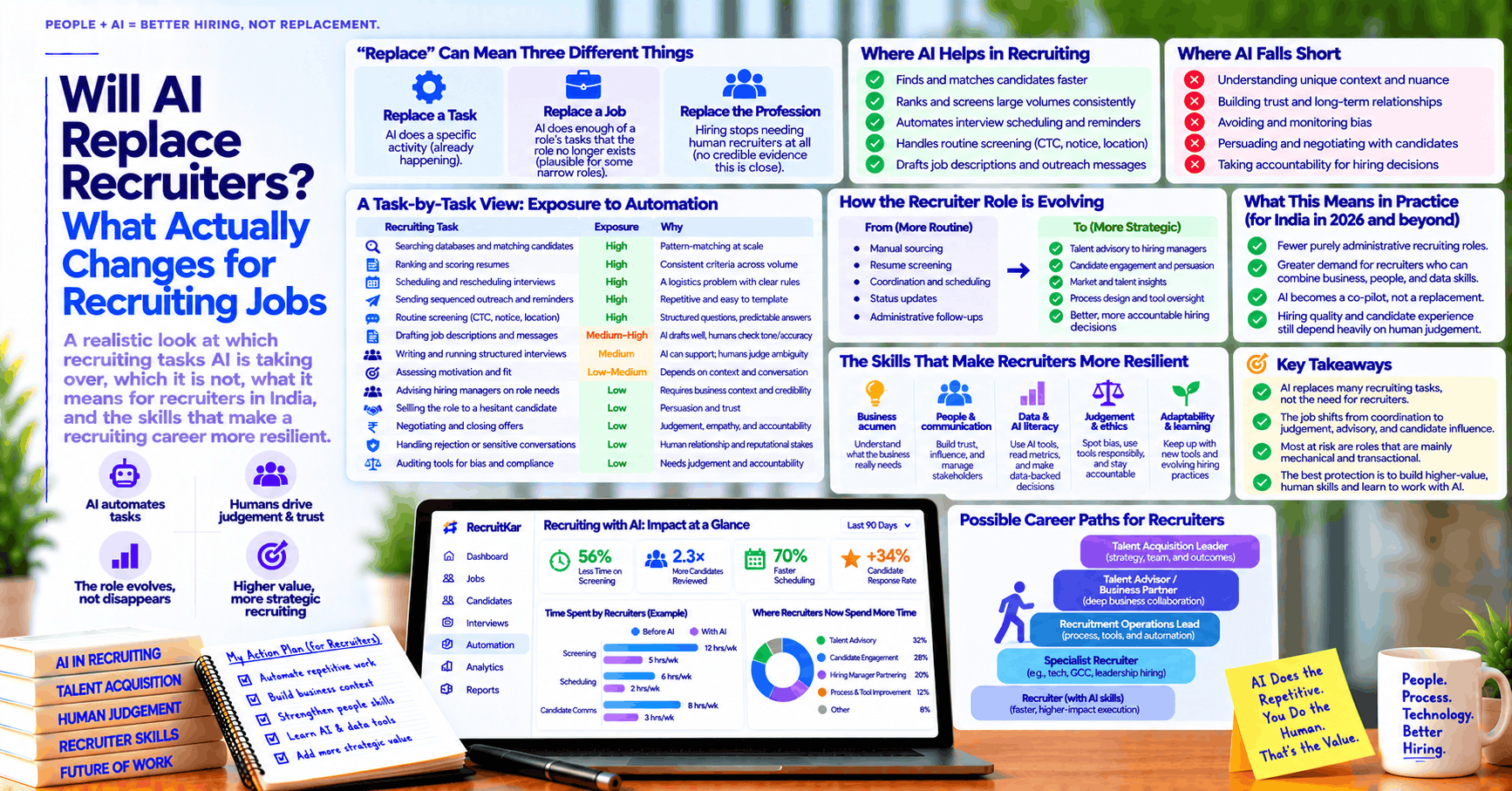
AI is already replacing recruiting tasks, such as searching databases, ranking resumes, coordinating interview slots, sending sequenced outreach, and collecting routine screening answers. It is much less able to replace the parts of the job that depend on trust, judgement, persuasion, and accountability: advising a hiring manager, convincing a hesitant candidate, negotiating an offer, or handling a sensitive conversation well. So the realistic answer is not "recruiters disappear" or "nothing changes." It is that the job shifts toward the human parts, and recruiters whose work is mostly mechanical coordination will feel the pressure first.
We should say plainly that RecruitKar sells recruiting software, so we have an interest in this question; read our view with that in mind. You can see how we think about the human and automated split on our why RecruitKar page. This post sets out which tasks are exposed, which are not, what we don't know, and what recruiters can do about it.
"Replace" can mean three different things
Most arguments about this go in circles because people mean different things by "replace."
Replace a task. AI does a specific activity that a recruiter used to do. This is already happening and is not controversial.
Replace a job. AI does enough of a role's tasks that the role no longer exists in its current form. This is plausible for some narrow, mechanical roles.
Replace the profession. Hiring stops needing human recruiters at all. There is no credible evidence that this is close, and hiring is a high-stakes, relationship-driven activity where accountability matters.
Most of the real action is in the first two. The useful question is not "will AI replace recruiters?" but "which of my tasks will AI handle, and what is left that is worth paying a person for?"
A task-by-task map
This is our assessment, not a measured result. It reflects where current tools are strong and weak, and it will shift as the tools improve.
Recruiting task: exposure to automation (why)
Searching databases and matching candidates to a role: High (pattern-matching at scale is what current AI does well)
Ranking and scoring a large pile of resumes: High (consistent application of criteria across volume)
Scheduling interviews and rescheduling: High (a logistics problem with clear rules)
Sending sequenced outreach and reminders: High (repetitive, rules-based, easy to template)
Routine first-round data gathering (CTC, notice period, location): High (structured questions with predictable answers)
Drafting job descriptions and first-draft messages: Medium to high (AI drafts well; humans must check accuracy and tone)
Writing and running structured interviews: Medium (AI can support and score; humans still judge ambiguity)
Assessing candidate motivation and fit: Low to medium (depends on context and conversation)
Advising hiring managers on what the role really needs: Low (requires business context and credibility)
Selling the role to a hesitant or passive candidate: Low (persuasion and trust)
Negotiating and closing offers: Low (judgement, empathy, and accountability)
Handling rejection, sensitive, or senior conversations: Low (human relationship and reputational stakes)
Auditing tools for bias and compliance: Low (needs judgement and accountability)
Notice the pattern. The exposed tasks are repetitive, rules-based, and data-heavy. The protected ones involve ambiguity, relationships, and someone being answerable for the outcome.
What AI does well in recruiting, and what it does badly
Where it helps:
Finding relevant candidates in large pools faster than a person searching by hand
Applying the same criteria to every application without fatigue
Handling volume: hundreds of screening conversations or scheduling requests at once
Producing a decent first draft of a message, a job description, or a summary
Where it struggles:
Context. A candidate's unusual career path, a role that has quietly changed, a team's unspoken needs.
Trust. Candidates and hiring managers want to know a human is accountable.
Bias. AI trained on historical data can reproduce historical bias. It needs human oversight, not blind trust.
Persuasion. Convincing a strong passive candidate to leave a good job is a relationship skill.
Accountability. When a hire goes wrong, someone has to explain the decision. That cannot be delegated to software.
An arms race that increases the need for judgement
One underappreciated effect: AI is changing the candidate side too. Candidates can generate polished resumes and cover letters in seconds, and apply to far more roles. That means more applications, many of them looking similar, which makes screening harder, not easier.
In that environment, the value of human judgement in telling genuine capability from polished presentation goes up. Verification, structured evaluation, and good interviewing matter more when surface signals are cheap to produce. Recruiters who can design and run assessments that reveal real skill are in a stronger position than those who rely on resume reading alone.
The Indian context
A few features of the Indian market shape how this plays out.
Volume hiring is where automation bites first. Roles that attract hundreds of applicants, such as customer support, sales development, frontline, and campus hiring, are where automated screening, scheduling, and voice or video first rounds save the most time. The repetitive coordination work that used to need a large team can be handled by far fewer people.
Relationship-heavy hiring stays human. Senior, specialist, and leadership hiring depends on trust and discretion. Offer negotiation, managing counter-offers during long notice periods, and keeping a candidate committed for 60 to 90 days are human-intensive and hard to automate well.
Agencies face a specific shift. Agency recruiters who add value through network, judgement, and closing will keep it. Those whose value is mostly forwarding resumes face pressure, as clients can increasingly source and screen directly.
Language and access matter. Multilingual, mobile-first tools broaden who can be screened, which changes where talent comes from but not the need for someone to decide who to hire.
Which recruiters are most exposed, and which are more resilient
Being straightforward about this: no one can predict individual outcomes, and this is a general pattern, not a forecast.
More exposed: roles built mainly around manual resume forwarding, interview-scheduling coordination, spreadsheet updating, and templated messaging. If most of your week is tasks the table above rates "high," that is where the pressure will concentrate.
More resilient: recruiters who:
Build credibility with hiring managers and shape what the role actually is
Source niche or senior talent through relationships and judgement
Close offers and manage candidates through notice periods
Run rigorous, structured selection processes
Understand the business well enough to advise, not just fulfil requests
Know how to evaluate and audit AI tools, including for bias and data protection
Skills worth building
Structured interviewing and assessment design. Knowing how to build a rubric and evaluate evidence is more valuable when screening gets automated.
Consulting with hiring managers. Moving from taking orders to challenging and clarifying requirements.
Negotiation and closing. Understanding compensation, motivation, and how to handle counter-offers.
Data fluency. Reading funnel metrics, source quality, and quality of hire, and acting on them.
AI tool literacy. Knowing what a tool does, how to check its output, where it can be wrong, and how to ask a vendor hard questions about bias and data handling.
Compliance awareness. DPDP consent, fair screening, and the labour-law context of the hires you make.
Employer branding and candidate experience. Shaping how candidates experience the process is a human craft.
Workflow design. Knowing which parts of your process to automate and which to protect.
For HR leaders: introducing AI without hollowing out your team
If you are deploying AI in recruiting, how you do it affects both results and people.
Redeploy freed time deliberately. If automation saves a recruiter ten hours a week, decide what those hours go to: more hiring-manager conversations, better candidate follow-up, stronger offers. If you simply cut capacity, you lose the human judgement the tools depend on.
Keep humans in decisions that matter. Use AI to narrow and prioritise; keep people responsible for who advances and who gets an offer.
Audit the tools. Ask vendors how bias is tested, how transcription performs across Indian accents and languages, and how candidate data is handled.
Train your team. People use tools better when they understand them and are not afraid of them.
Measure outcomes, not just speed. Track quality of hire and candidate experience alongside time-to-hire.
A practical 90-day plan for a recruiter
Days 1 to 30: audit your own work. Track for two weeks where your time actually goes. Tag each task as mechanical or judgement-based. This tells you how exposed your current role is.
Days 31 to 60: automate the mechanical, deliberately. Use tools for scheduling, outreach sequences, and screening, and spend the freed time on one human-heavy activity, such as a deeper hiring-manager intake or better candidate follow-up.
Days 61 to 90: build one differentiating skill. Choose one, such as structured interviewing, negotiation, or metrics, and apply it to a live role. Document the result so you can show it.
What we don't know
An honest answer includes uncertainty.
How fast the tools will improve. Capabilities that look limited today may not stay that way, particularly for conversational and agent-style tools.
How regulation will evolve. Rules on automated decision-making in hiring are tightening in several places and may constrain how far automation can go.
How candidates and hiring managers will respond. Acceptance of AI in hiring varies, and a backlash is possible if it is used badly.
What the net effect on headcount will be. Productivity gains can mean fewer recruiters for the same hiring, or more hiring for the same team. Which dominates will depend on the economy and on how companies choose to use the gains.
Anyone claiming certainty about the numbers is guessing.
Where RecruitKar fits, and where we draw the line
Our view, again with the caveat that we are a vendor: the mechanical work should be automated, and the decisions should stay with people.
RecruitKar's AI candidate discovery finds and ranks candidates, AI voice screening handles routine first-round conversations, calendar-integrated scheduling removes the back-and-forth, and the visual ATS pipeline keeps everything in one place. The recruiter reviews the shortlist, listens to the conversations that matter, makes the call, and does the persuading and closing. We are not trying to remove that part of the job, and we think a process that does would hire worse.
Frequently asked questions
Will AI replace recruiters completely? There is no strong evidence that it will, and hiring is a high-stakes, relationship-driven function where someone has to be accountable. What is changing is the mix of tasks. Mechanical work is being automated; judgement, persuasion, and relationship work becomes a larger share of the job.
Which recruiting tasks will be automated first? Candidate search and matching, resume ranking, interview scheduling, sequenced outreach and reminders, and routine first-round screening questions. These are repetitive, rules-based, and data-heavy, which is what current tools do best.
Should a fresher or junior recruiter be worried? Be realistic rather than alarmed. Junior roles often include a lot of the mechanical work that is most exposed, which means the entry-level job may look different from before. The better response is to build judgement-based skills early: learn structured interviewing, understand the business of the roles you fill, and get comfortable working with tools rather than against them.
Will AI make hiring fairer? It can, if designed and audited well. Consistent, rubric-based screening can reduce some individual inconsistency. But AI can also reproduce bias present in its training data, so it needs testing, transparency, and human review. Fairness depends on implementation, not on the technology alone.
What should I learn to stay valuable as a recruiter? Structured interviewing and assessment design, consulting with hiring managers, negotiation and closing, data fluency, and the ability to evaluate and audit AI tools. These are the areas where human judgement adds the most value and where automation is least likely to substitute.
See how we draw the line between automated and human. Explore why growing Indian hiring teams use RecruitKar to take over the mechanical work while recruiters keep the decisions, the relationships, and the offers.